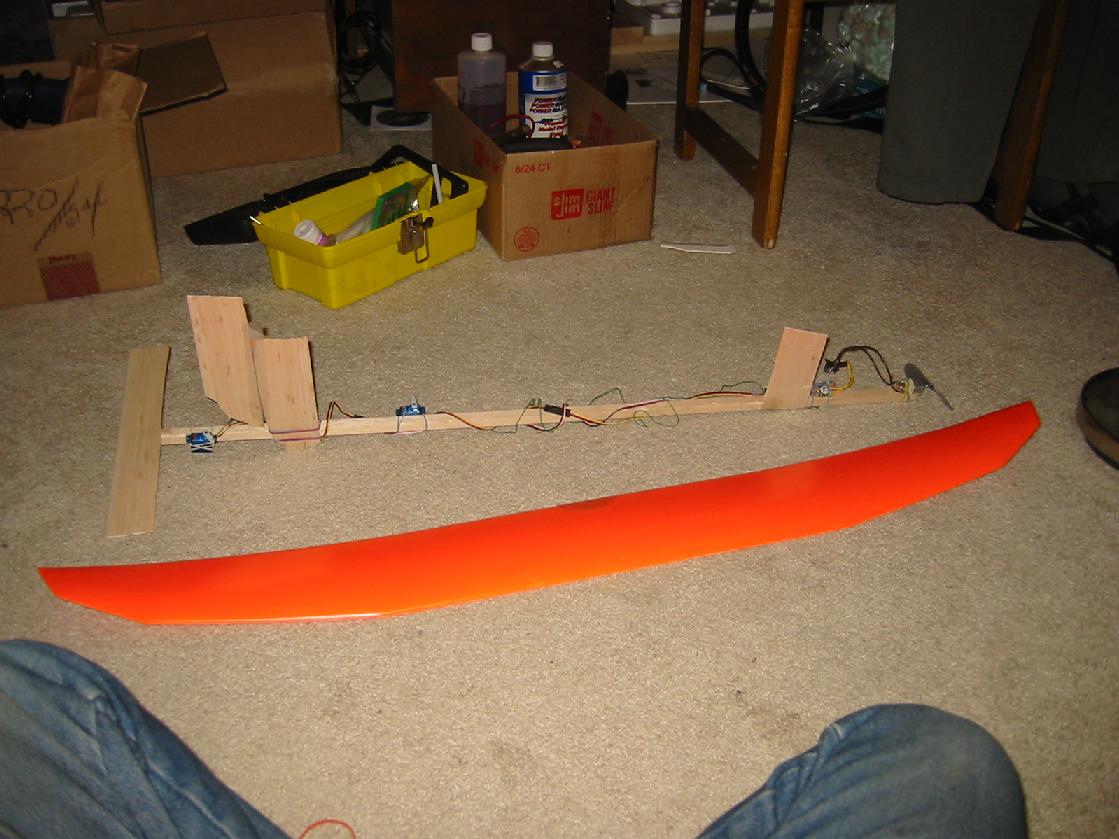
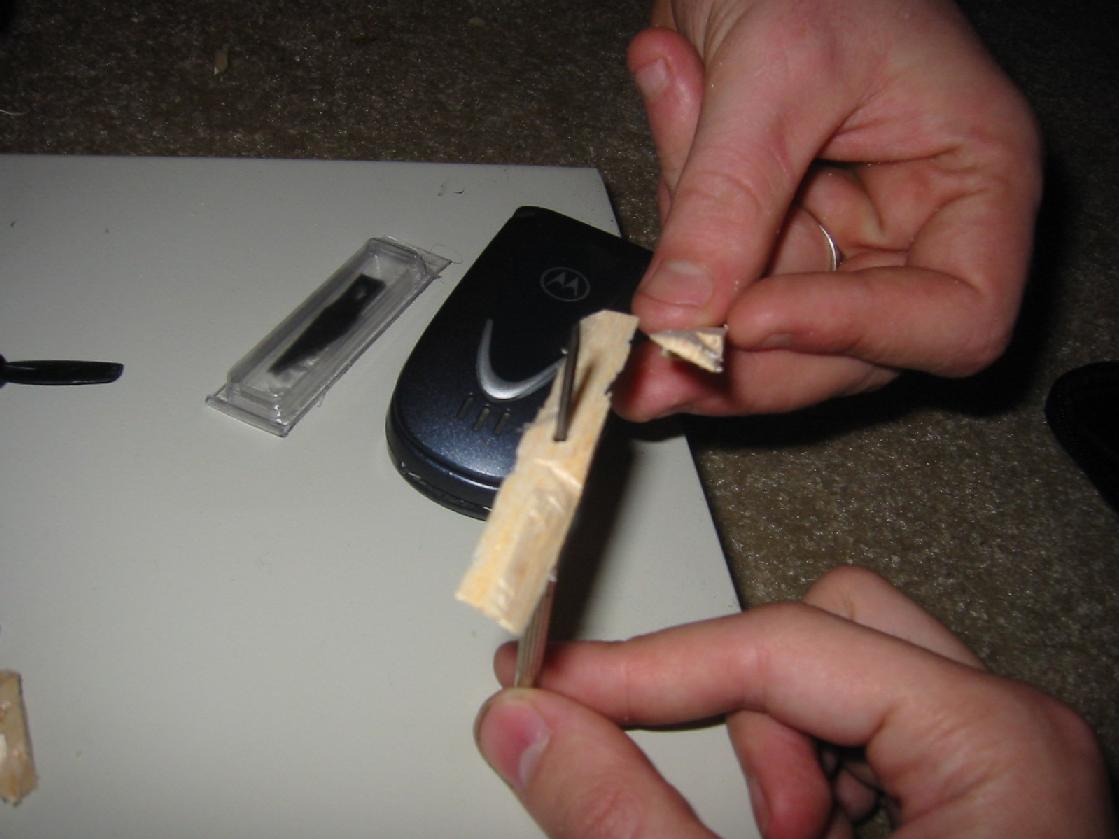
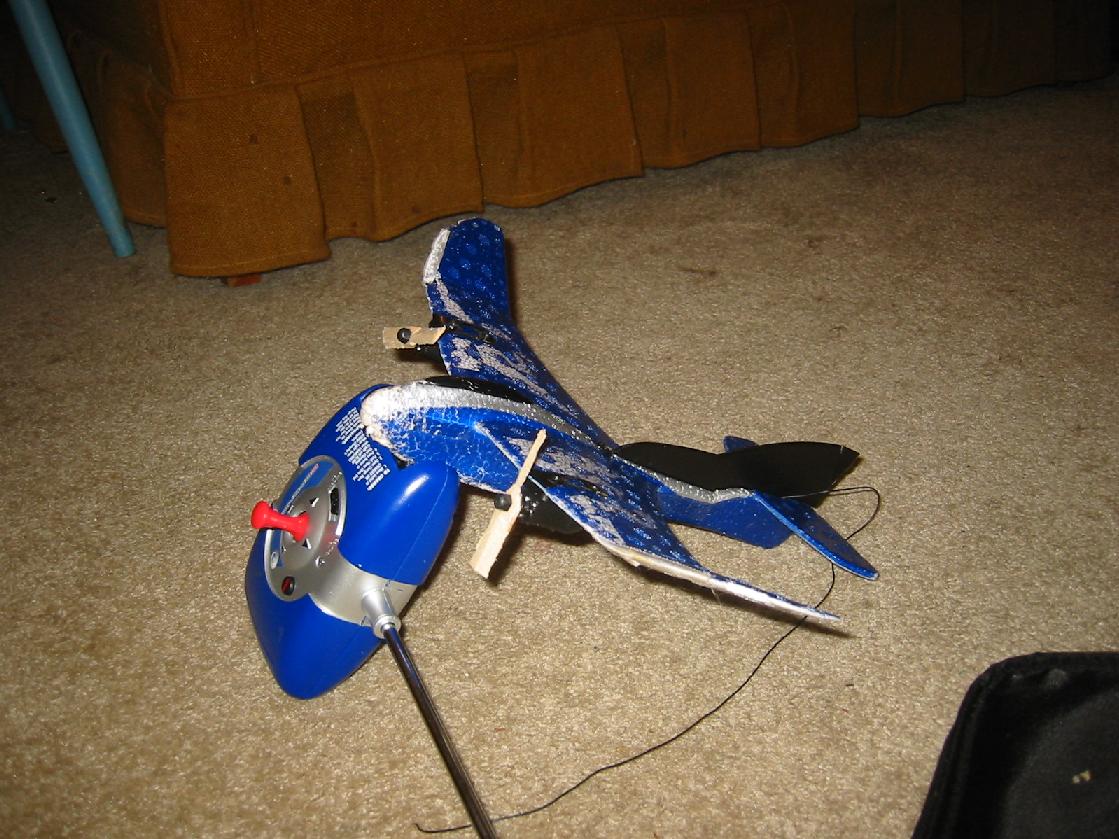
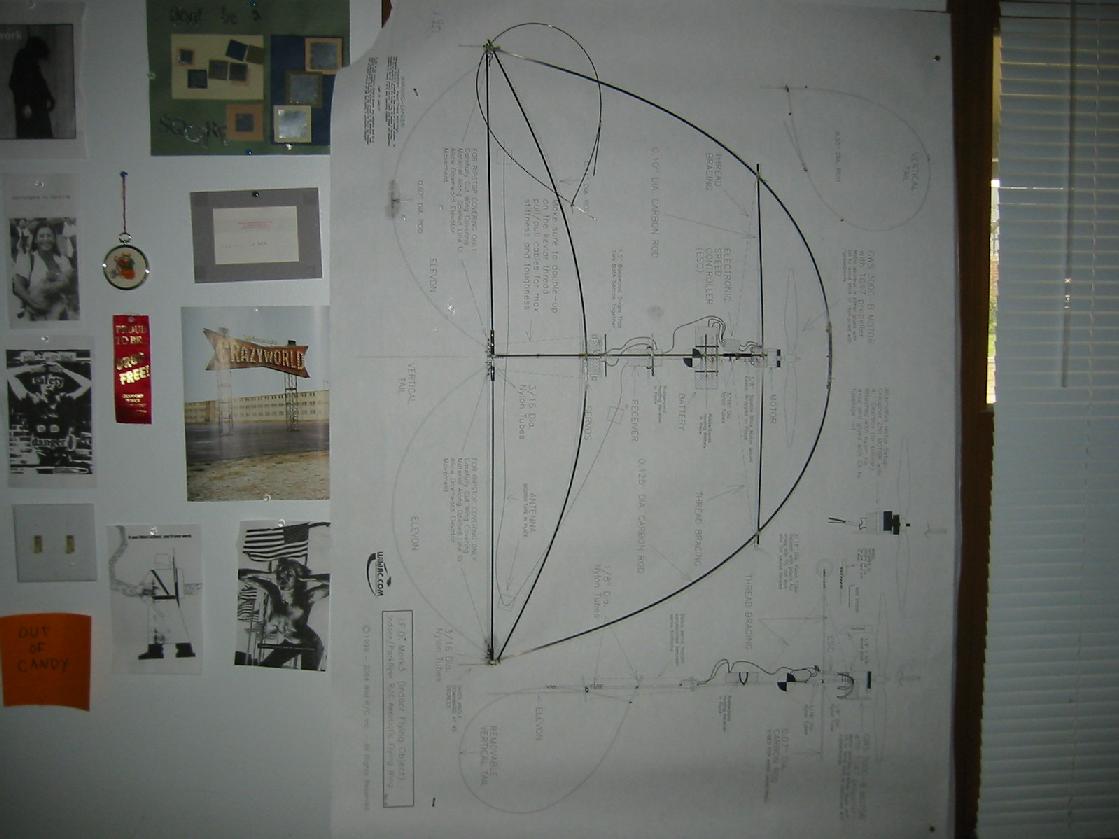
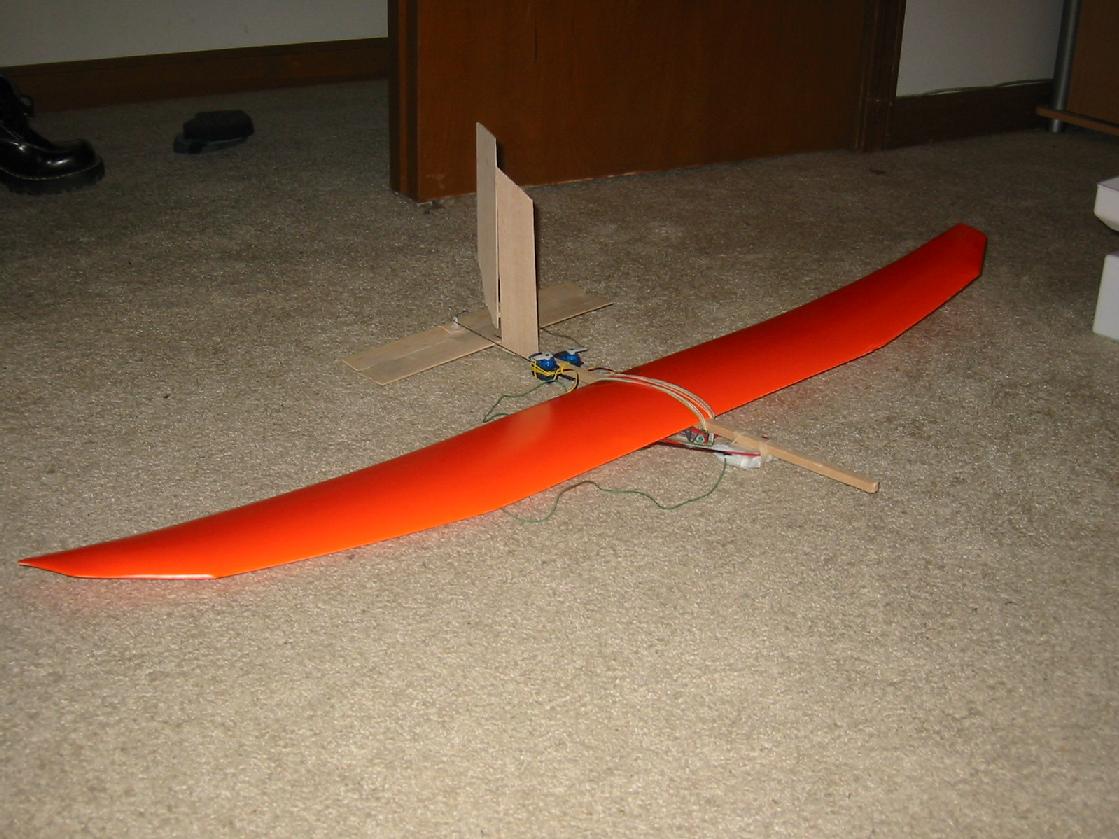
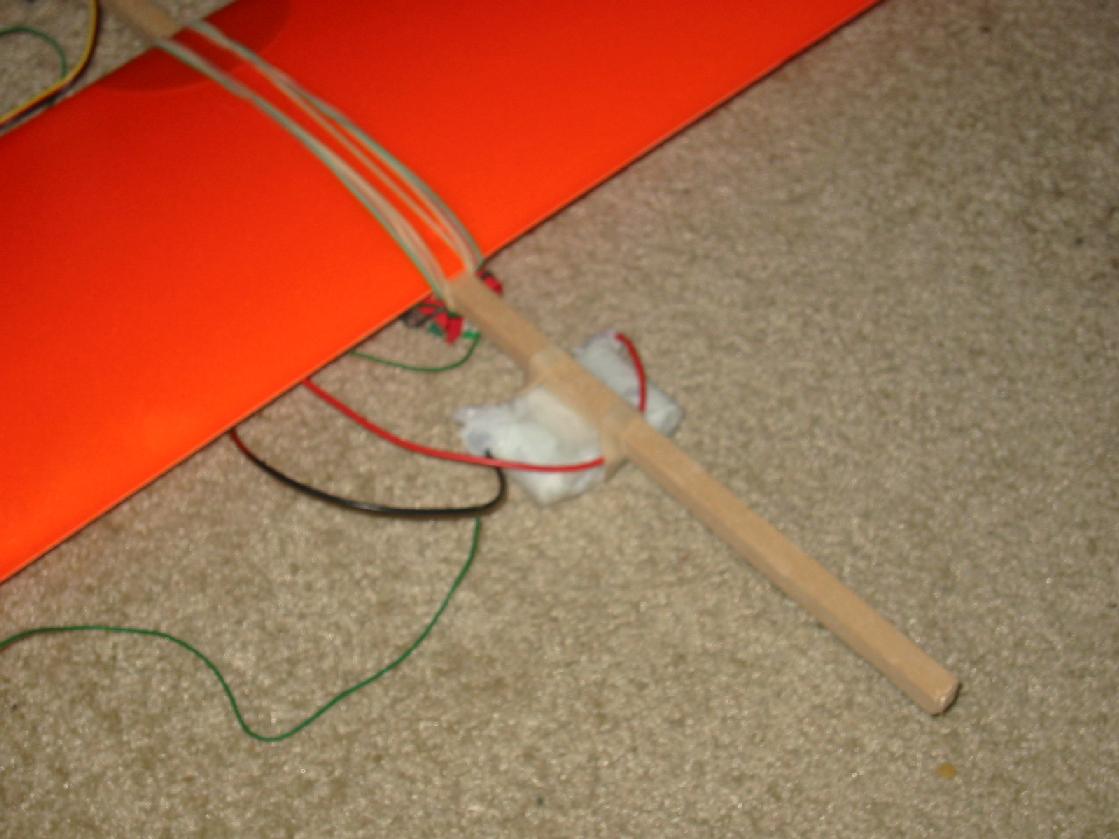
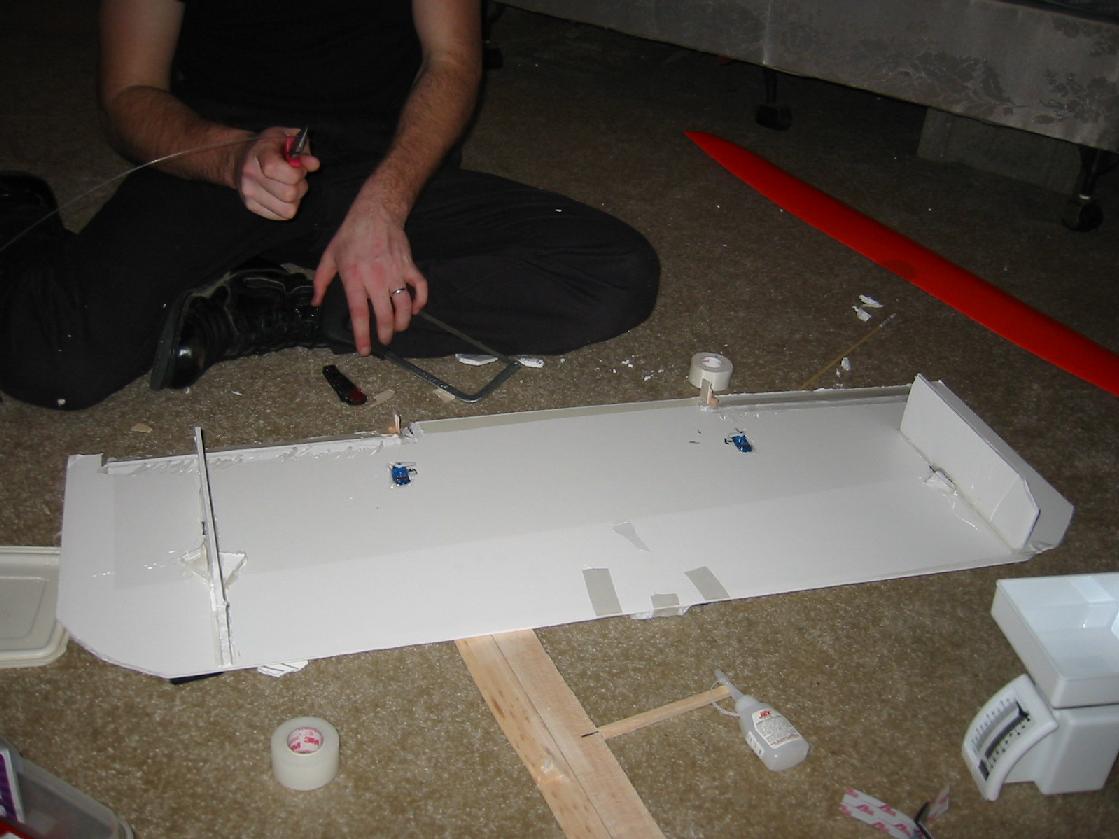
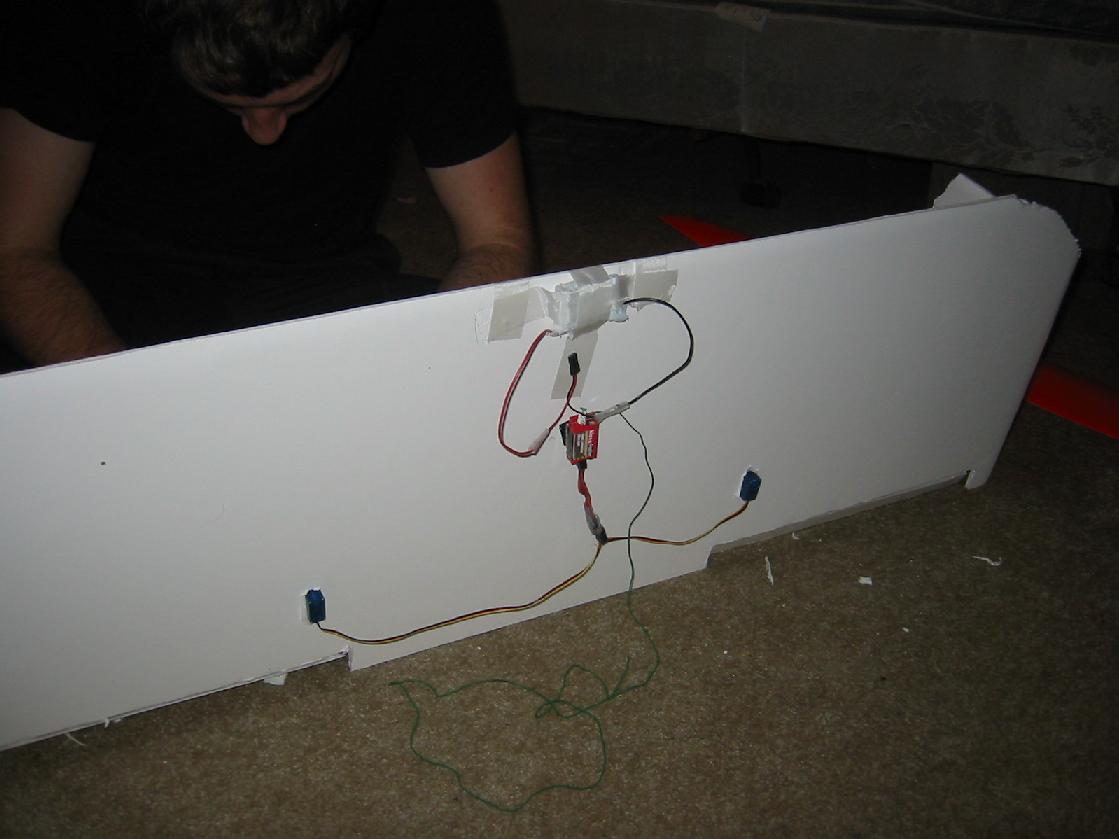
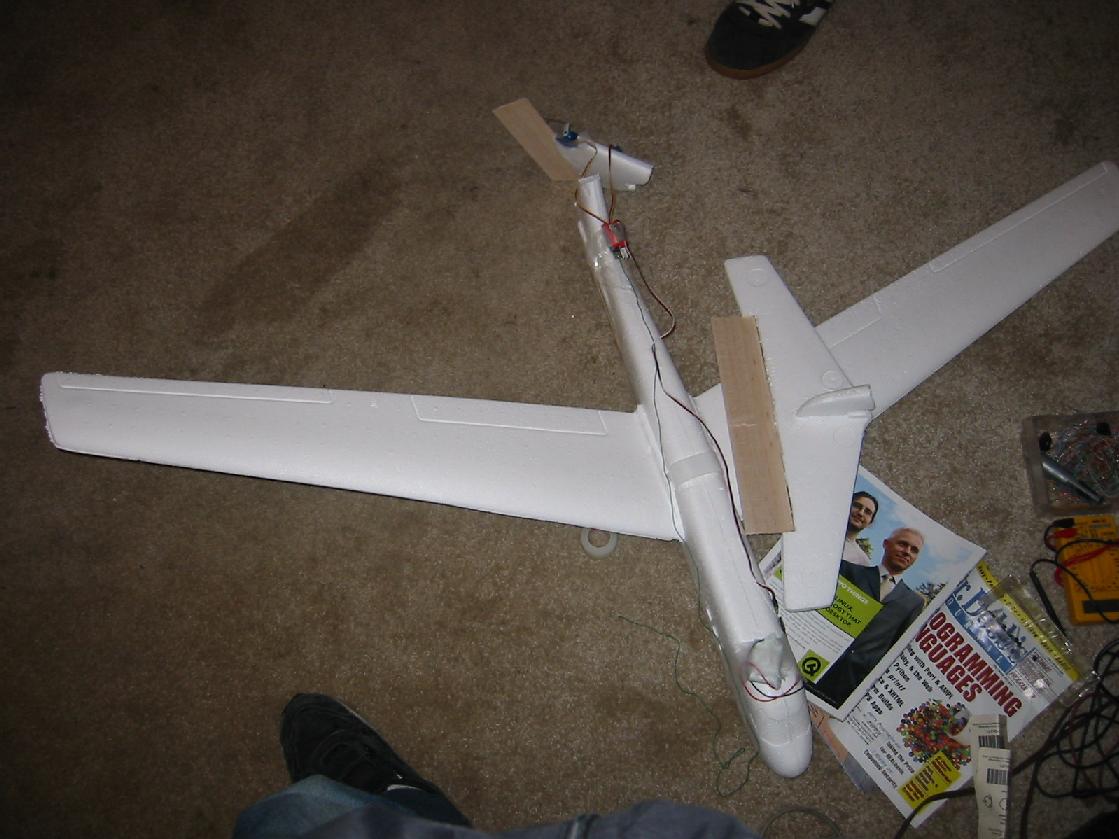
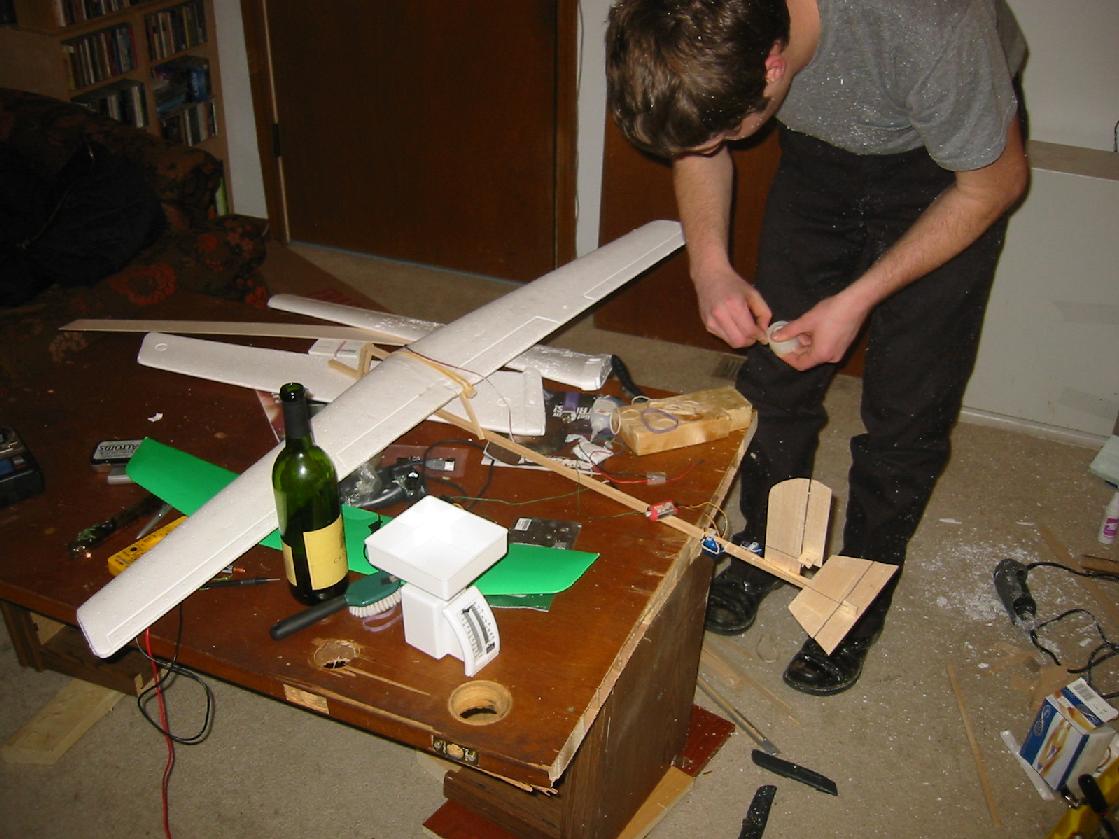
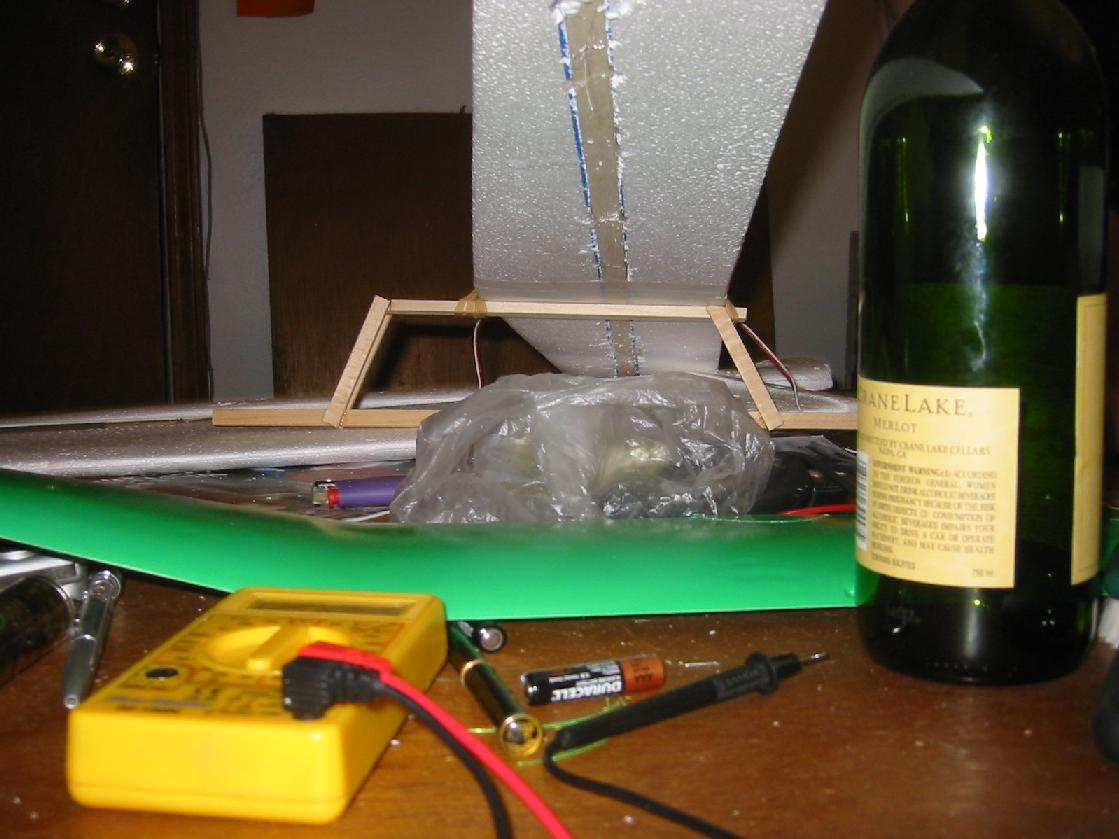
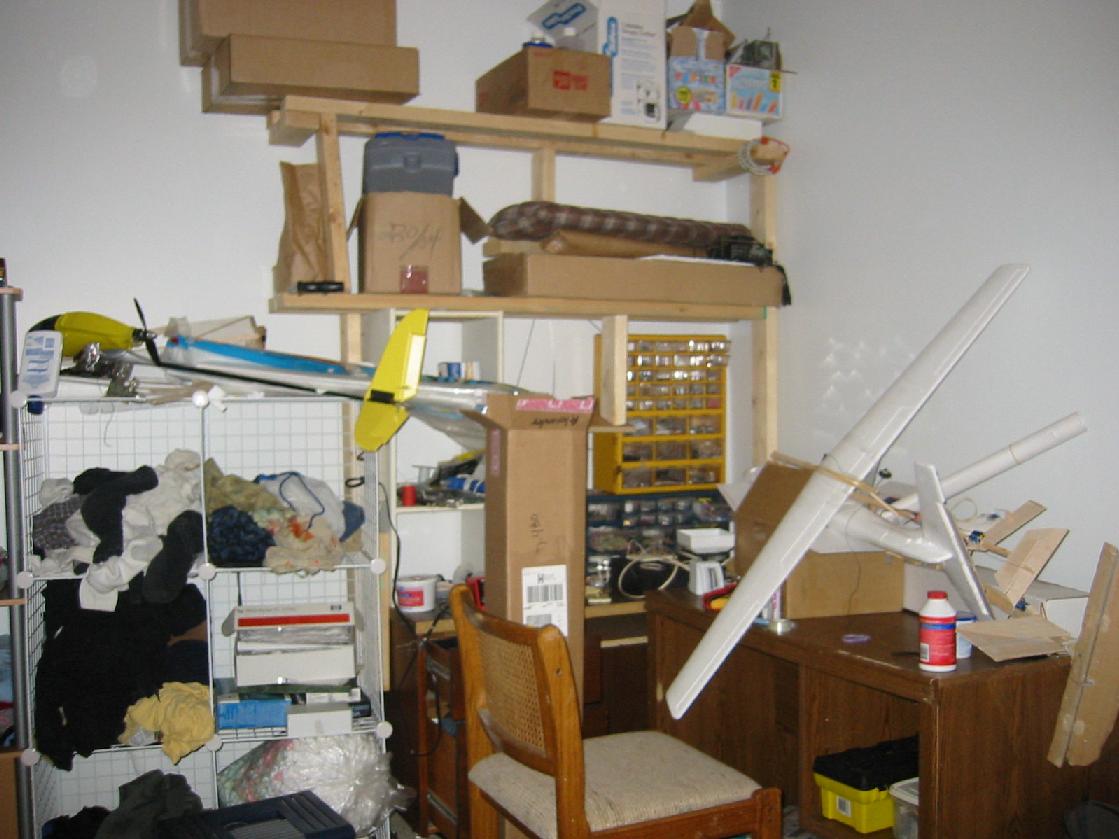
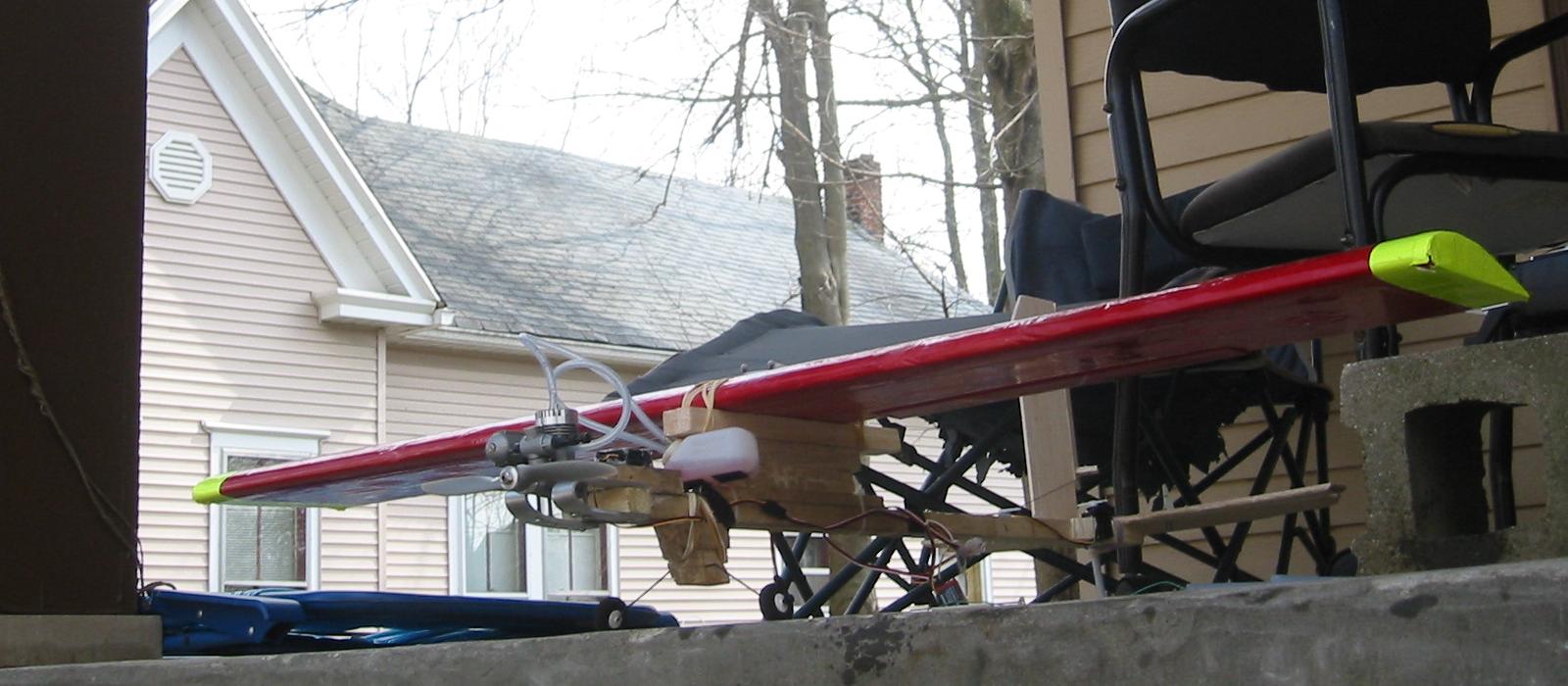
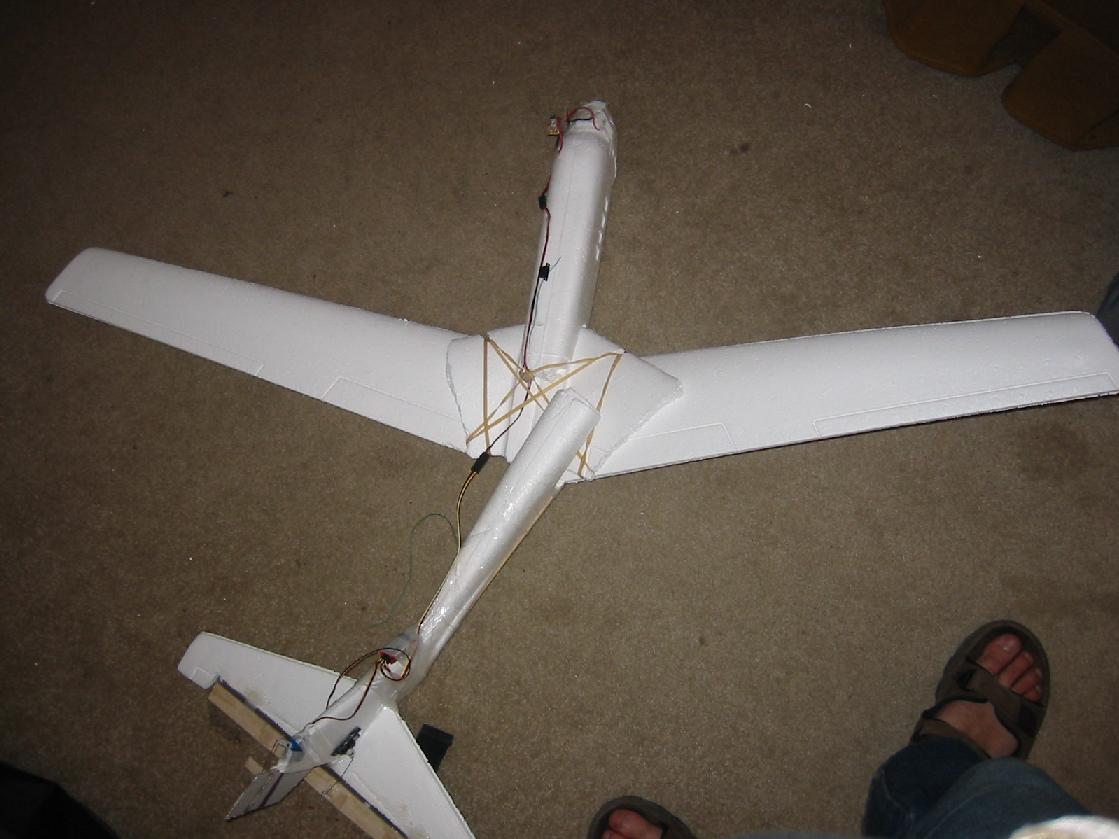
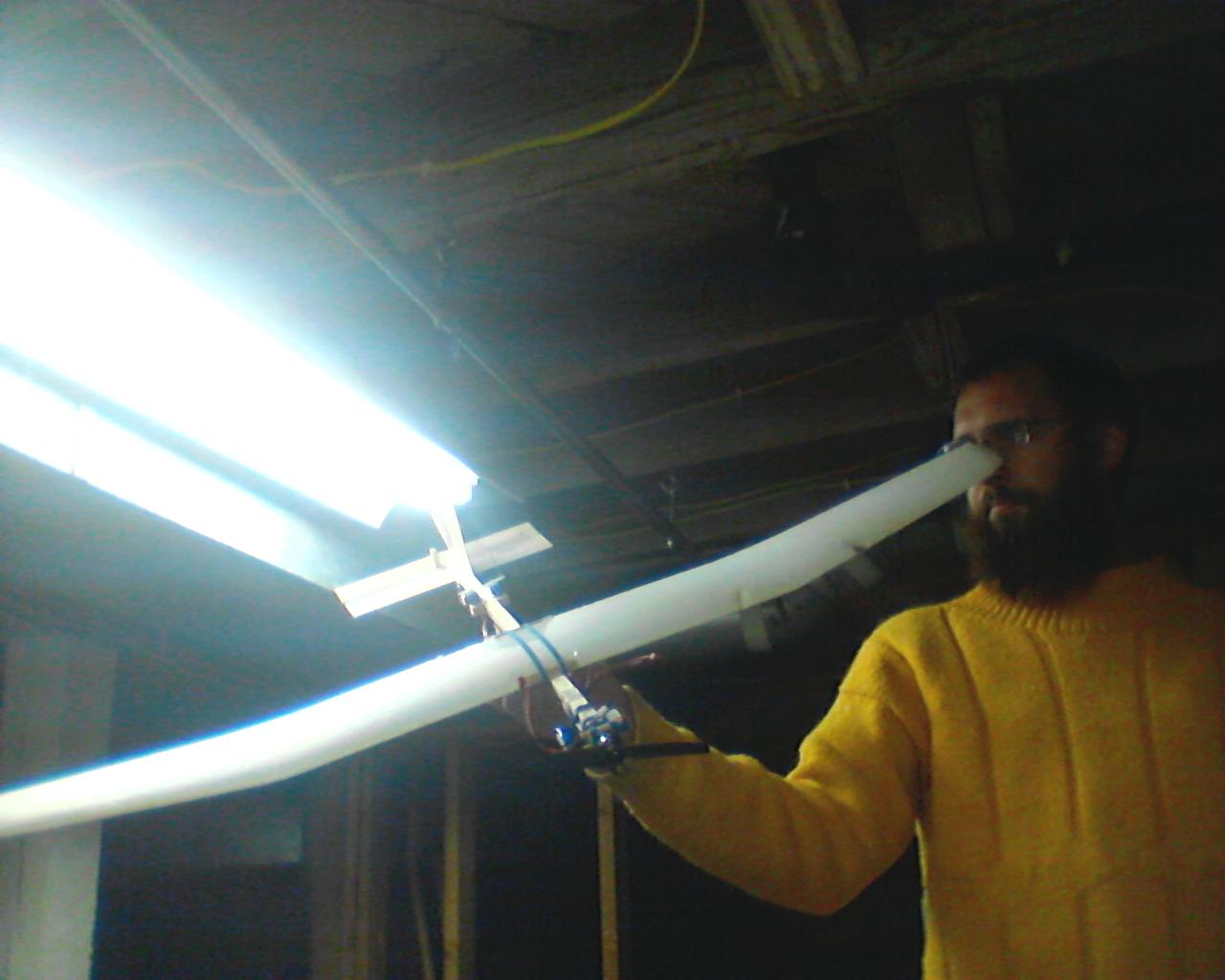
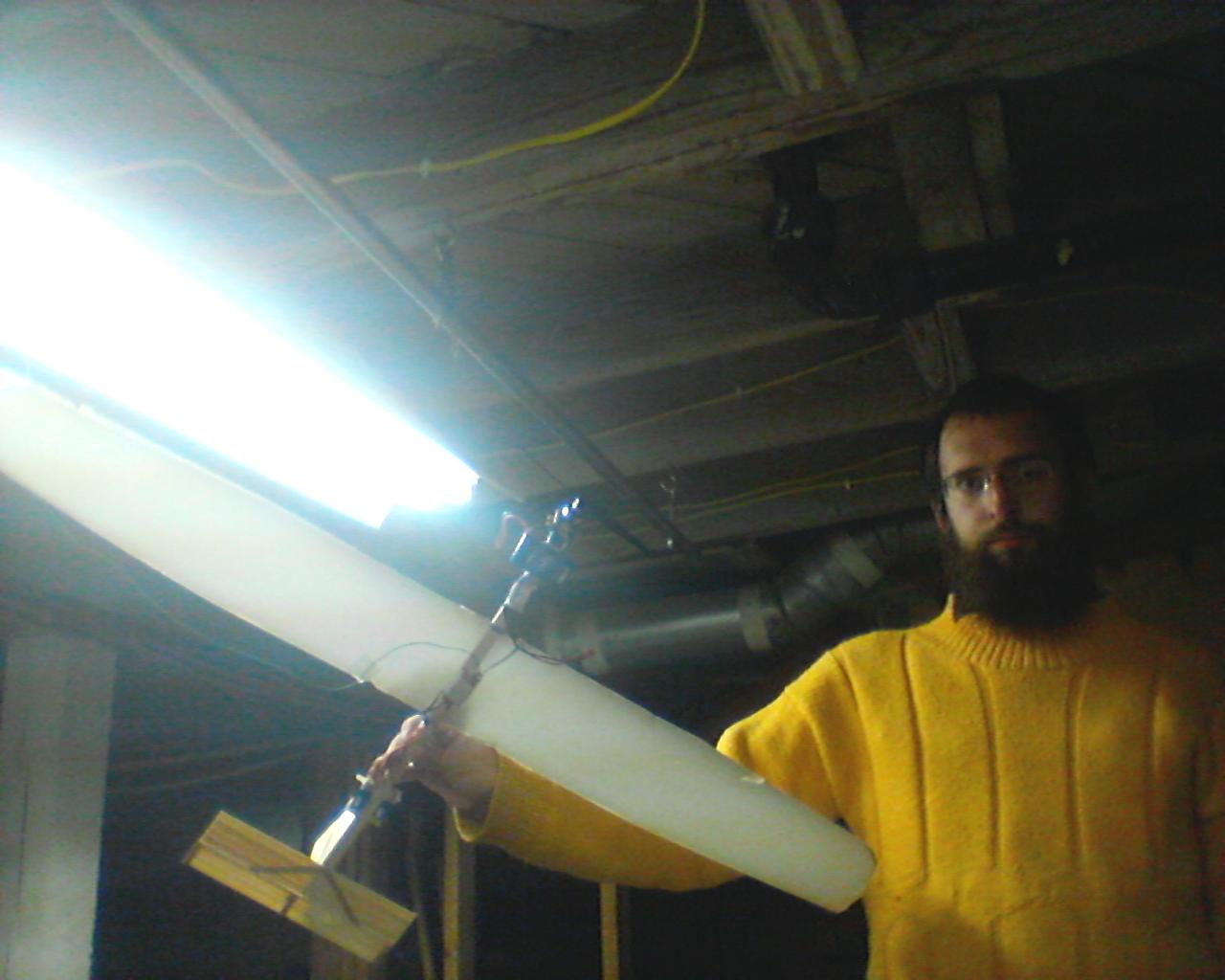
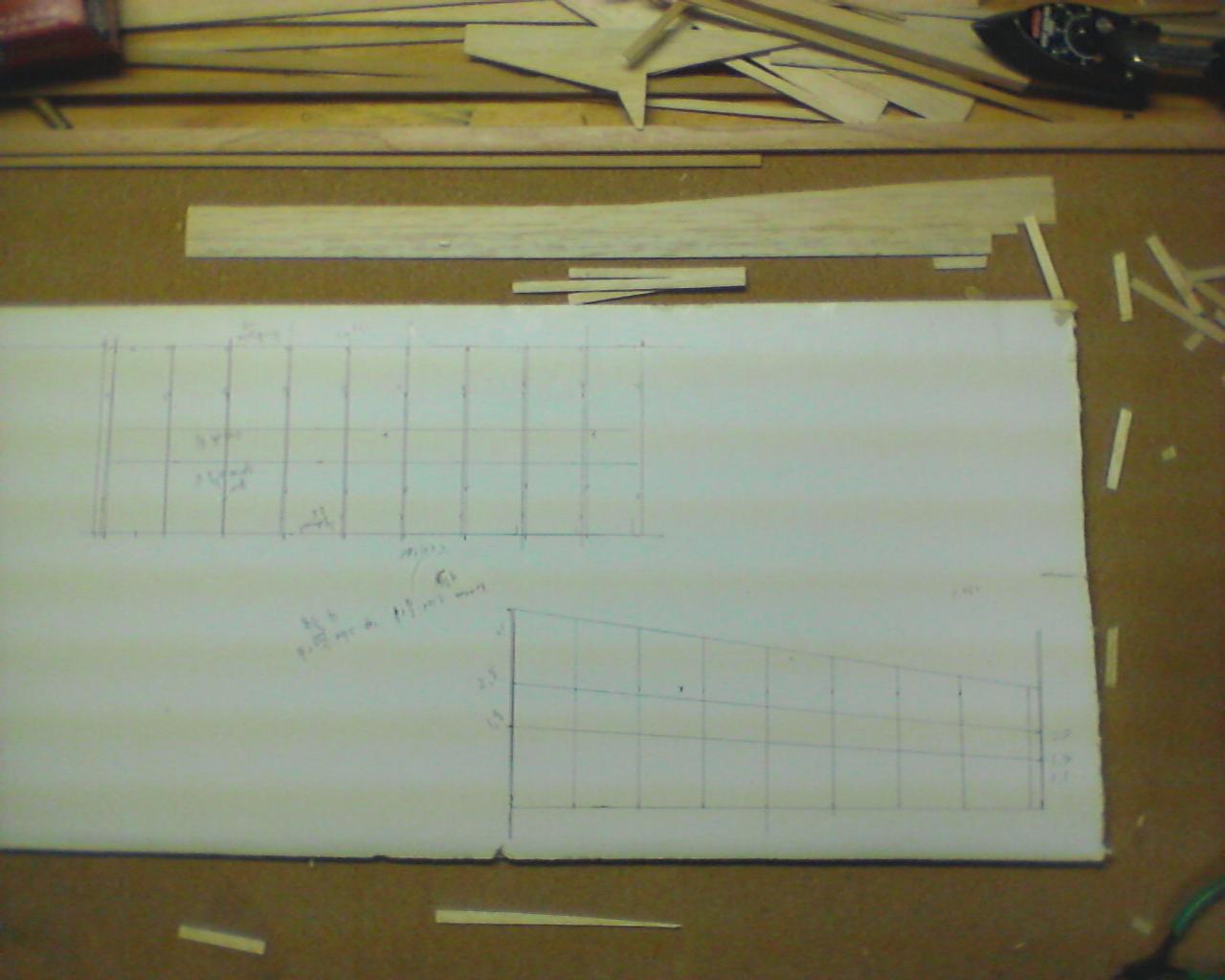
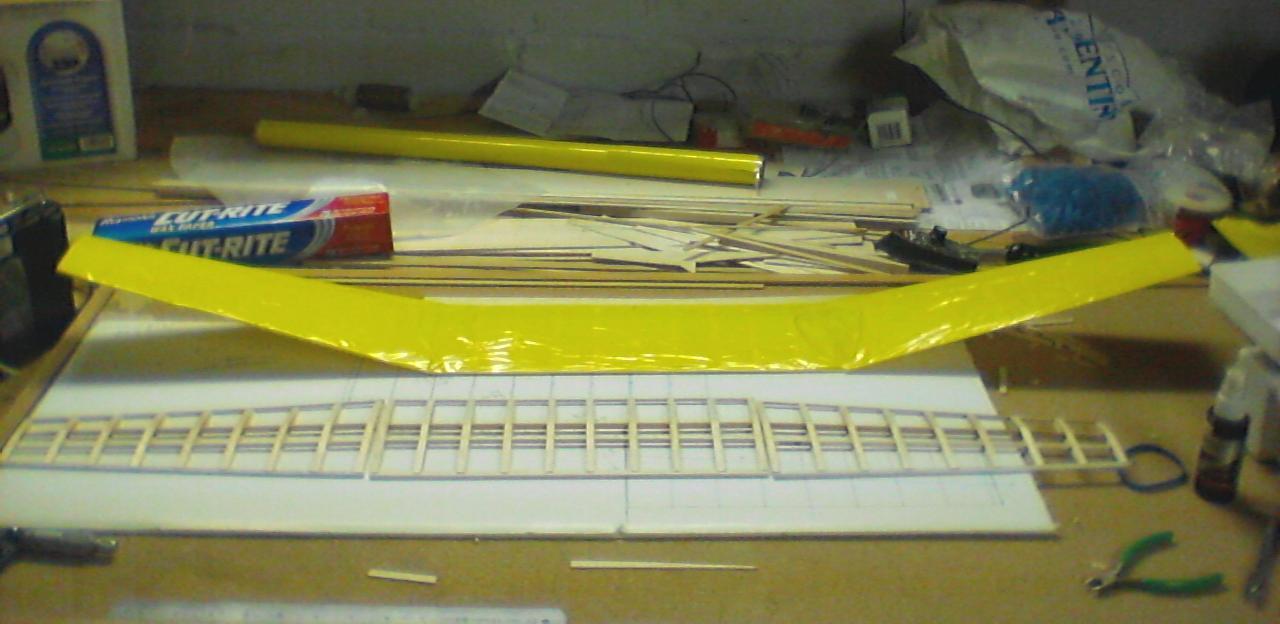
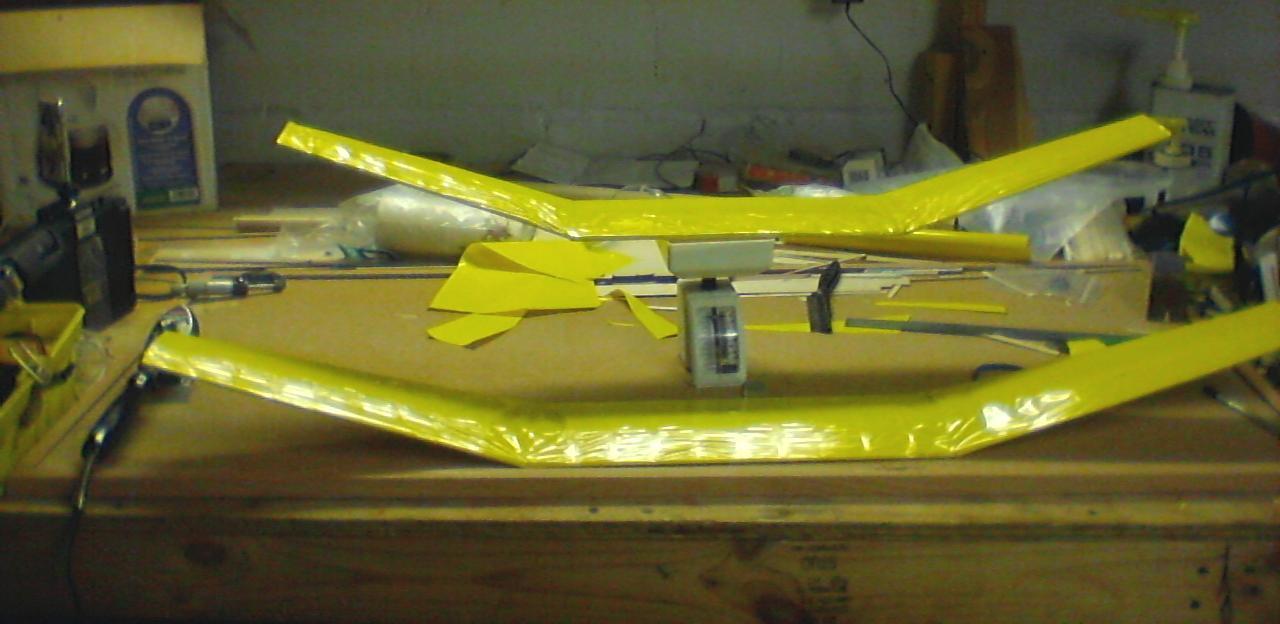
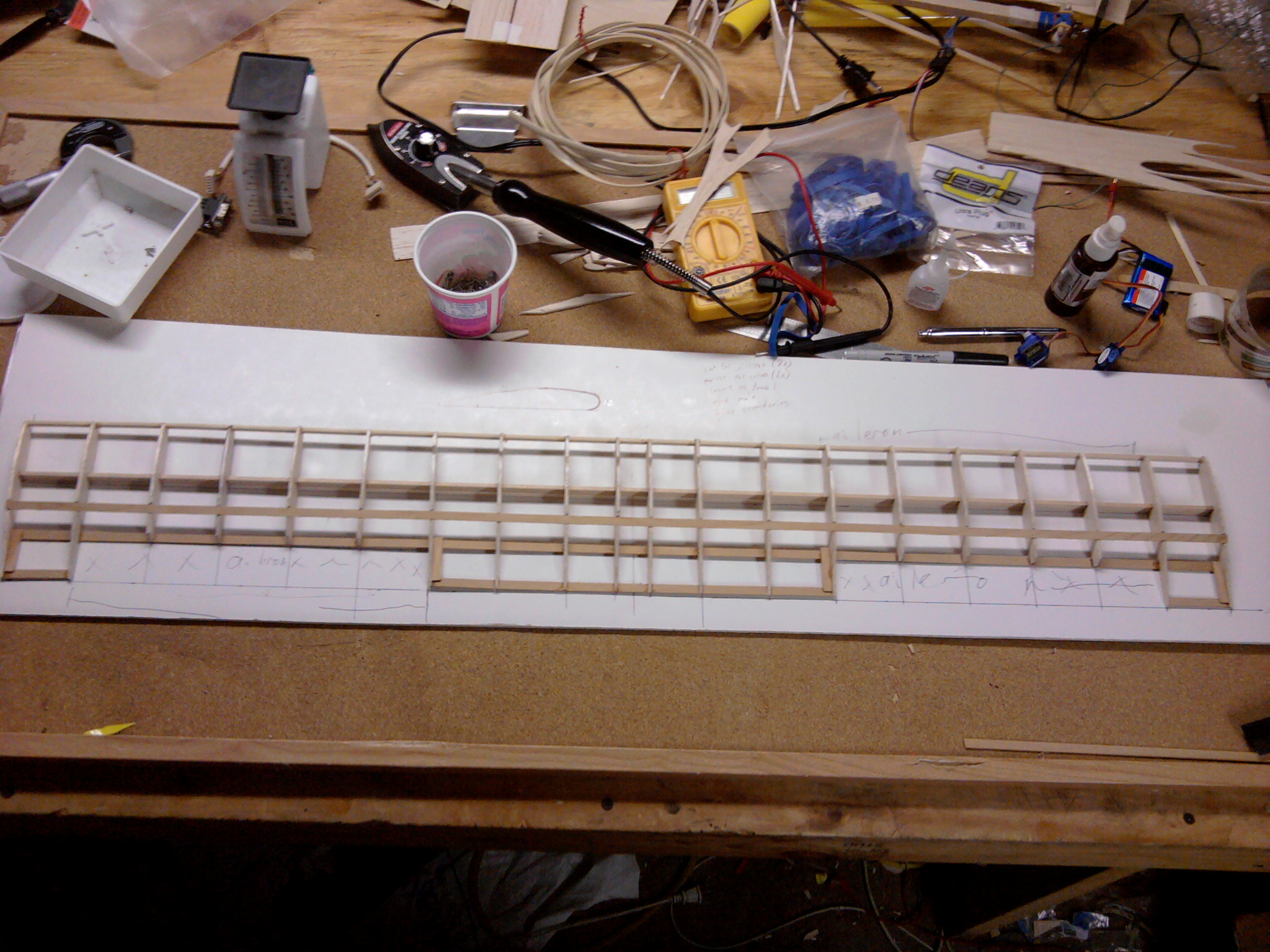
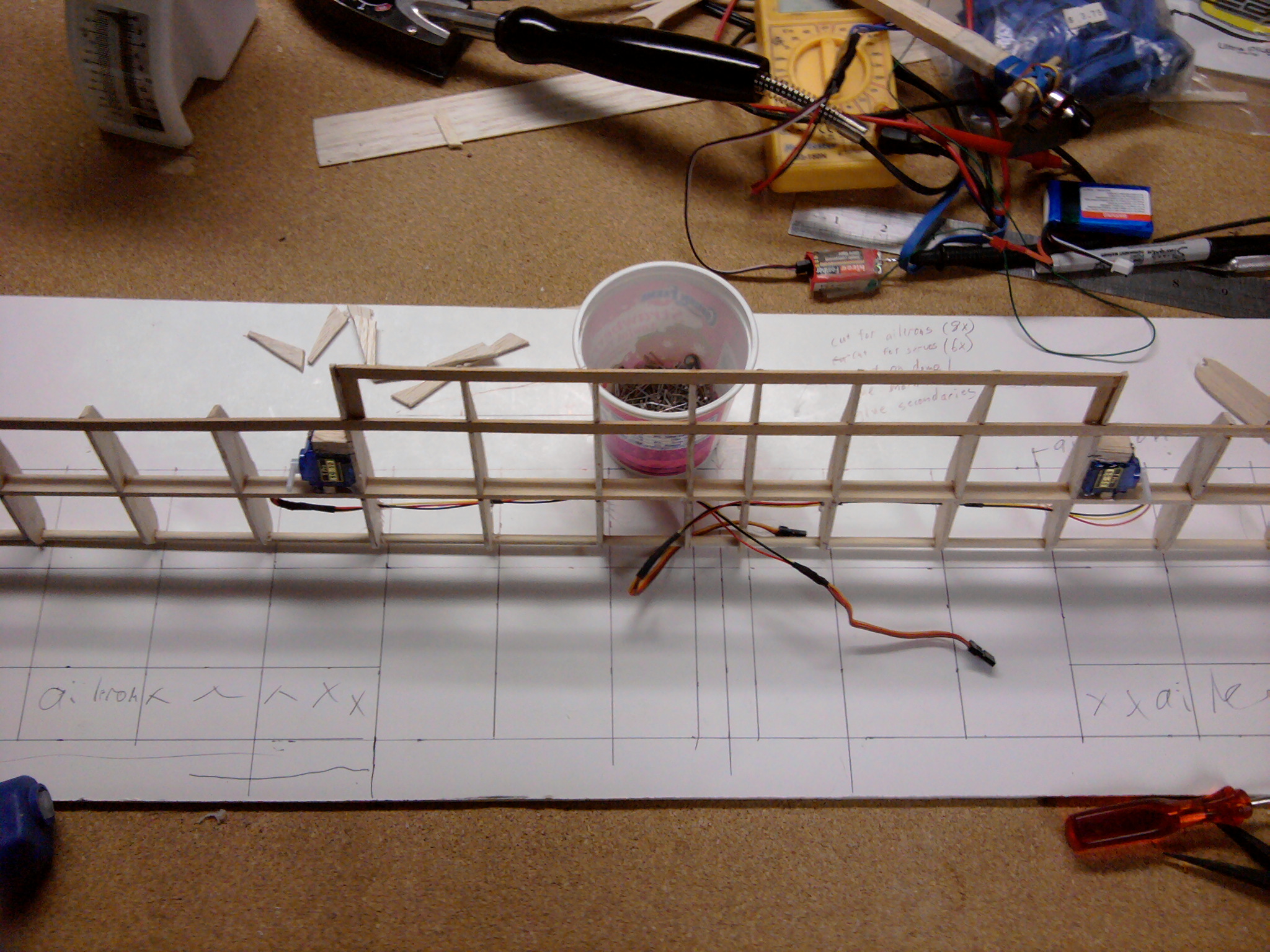
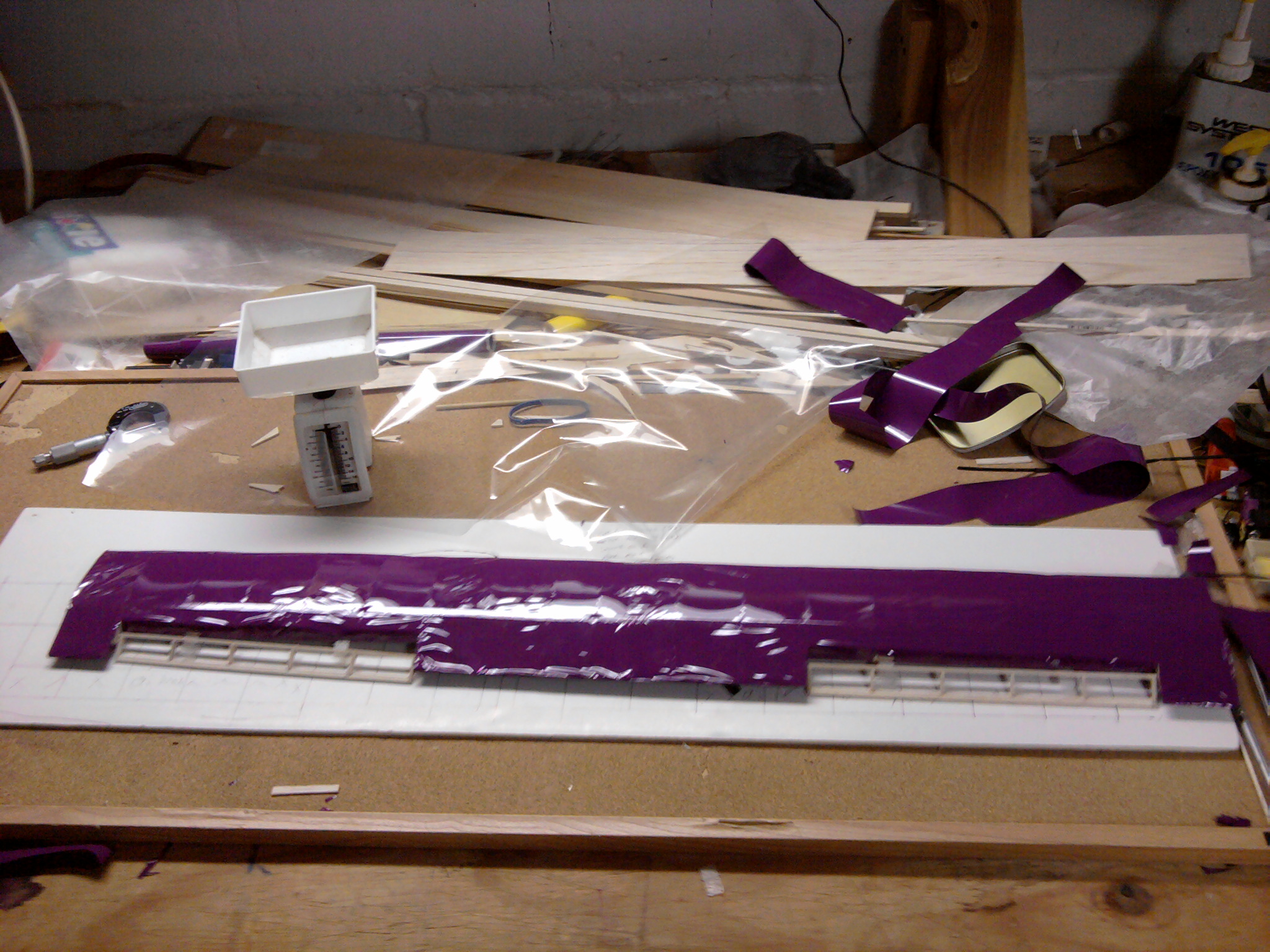
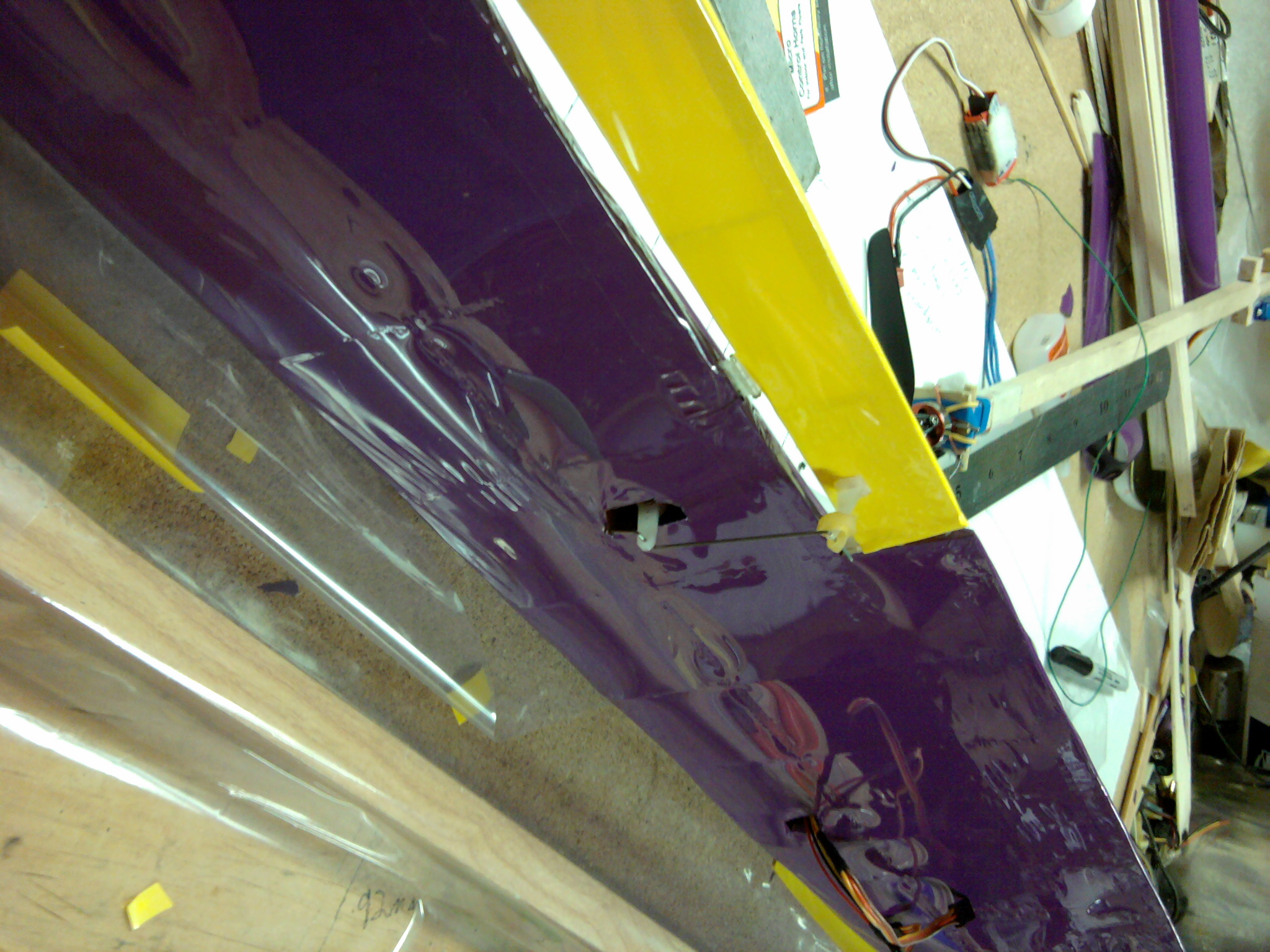
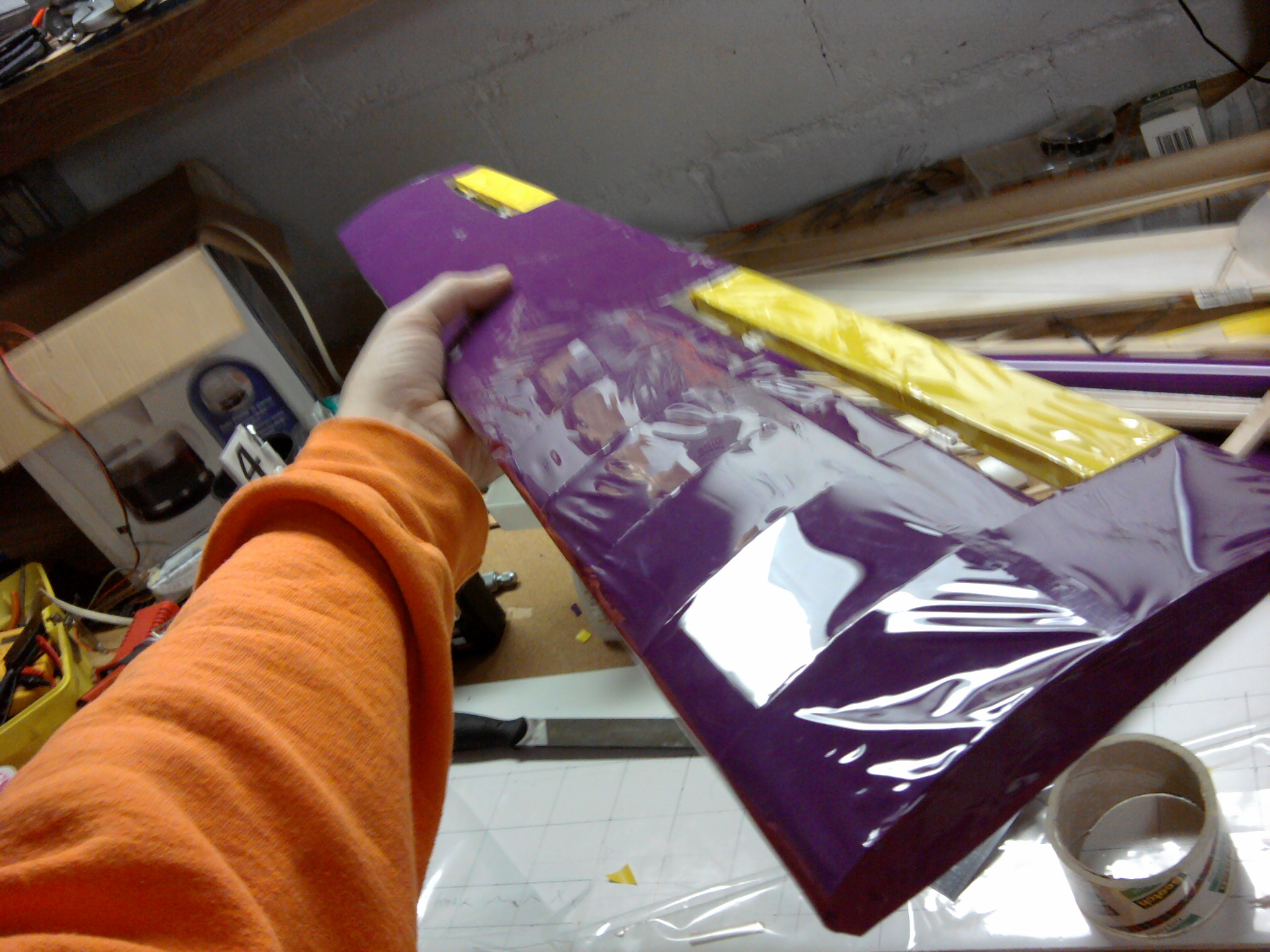
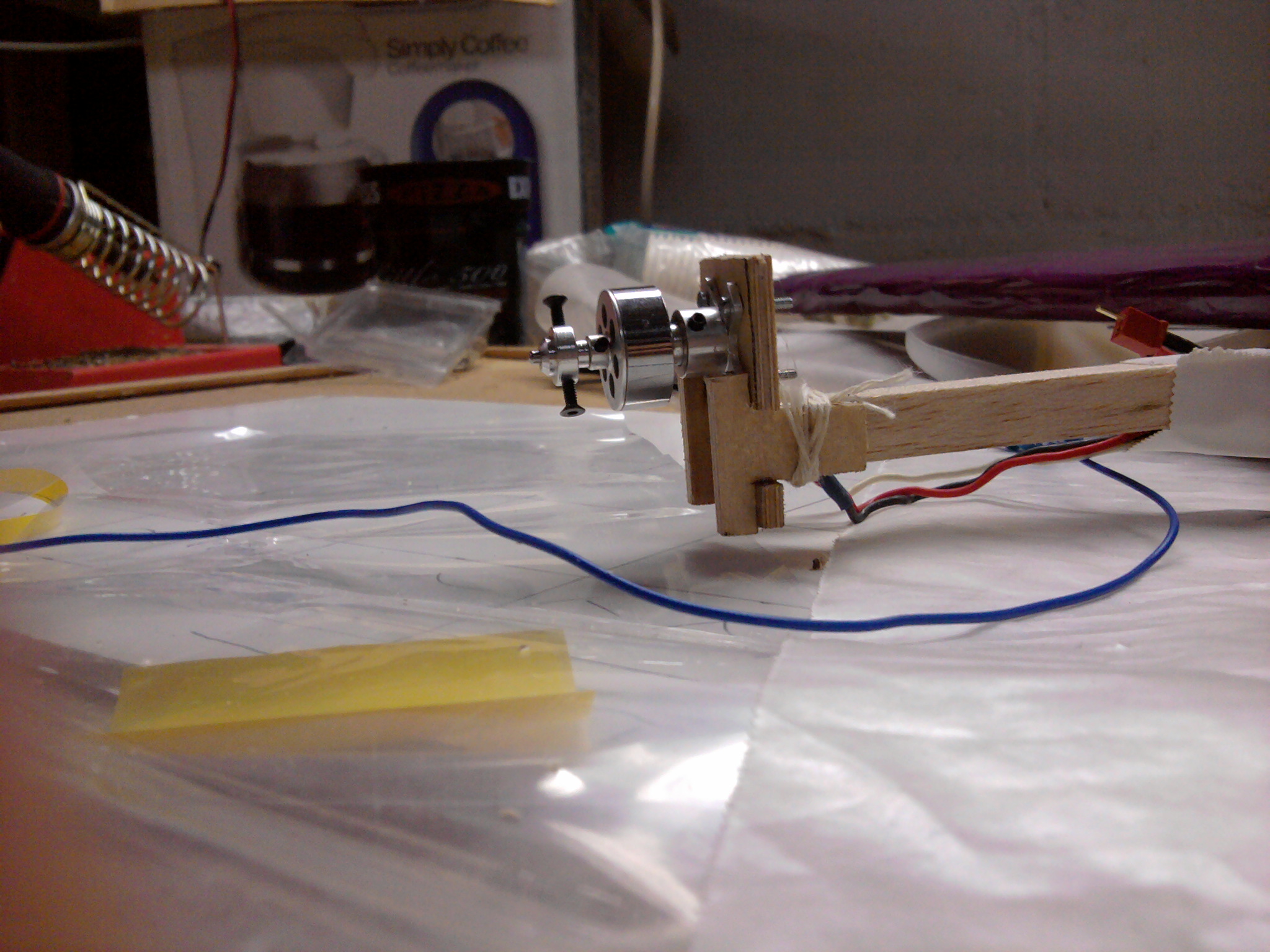
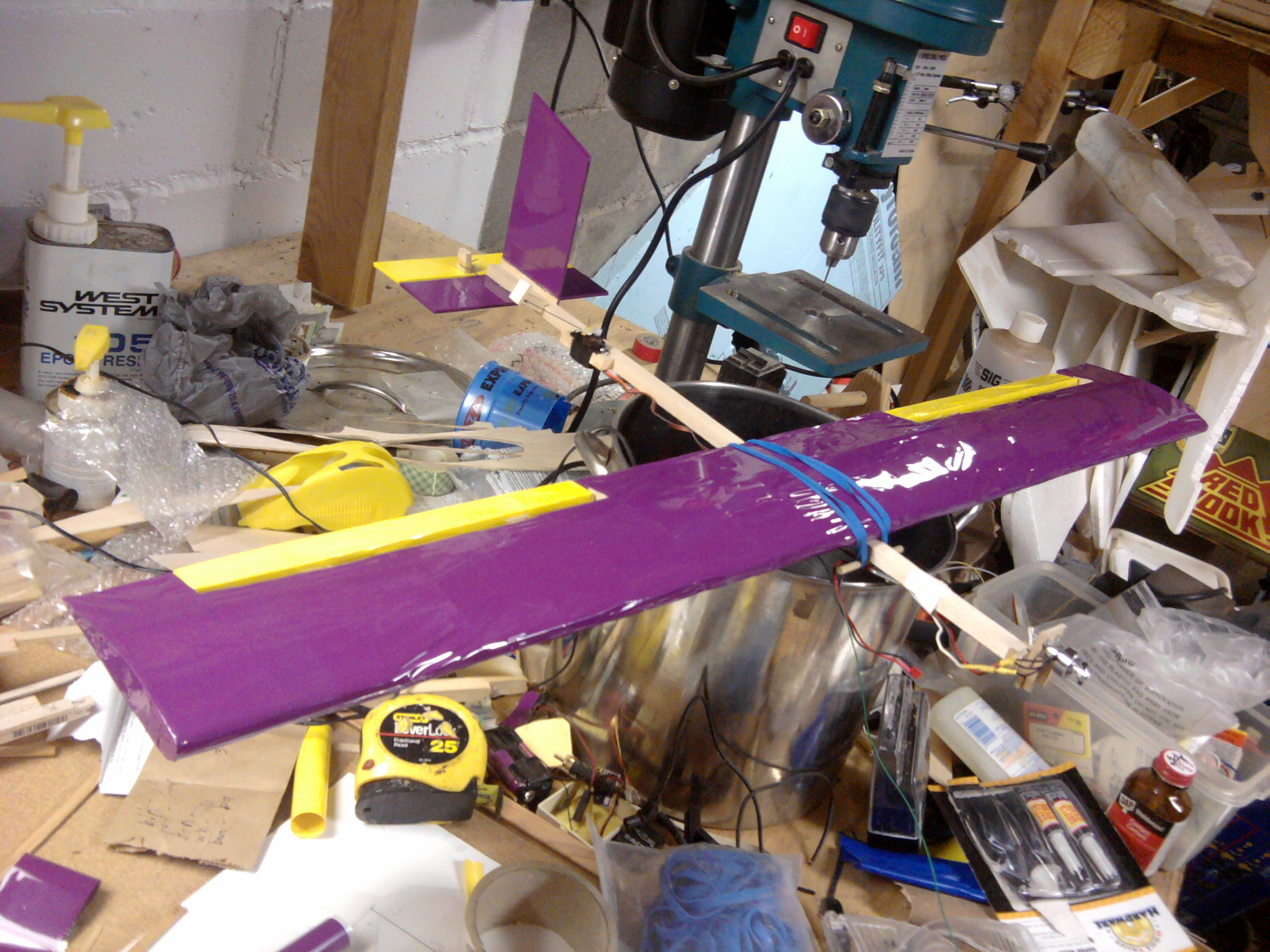
These are our experiments with radio control aircraft, most of them homebuit and more than a little bit crazy.
Click on any pictures here for a larger version.
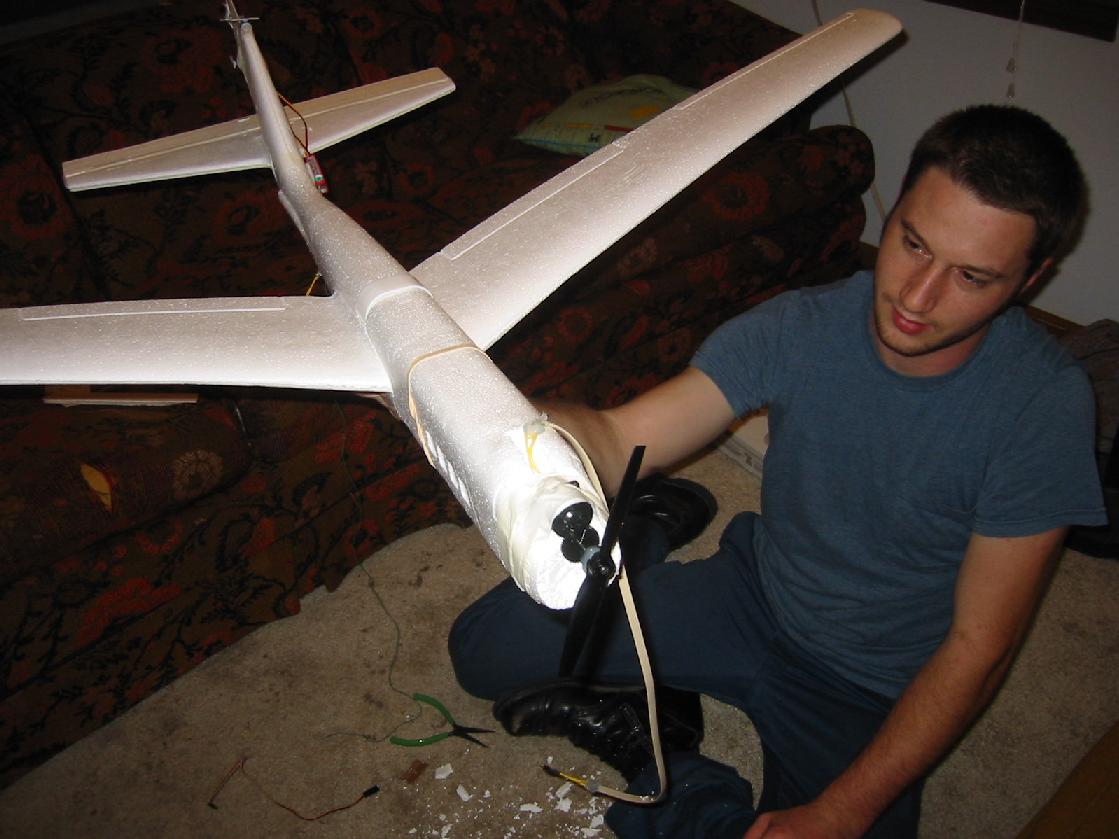
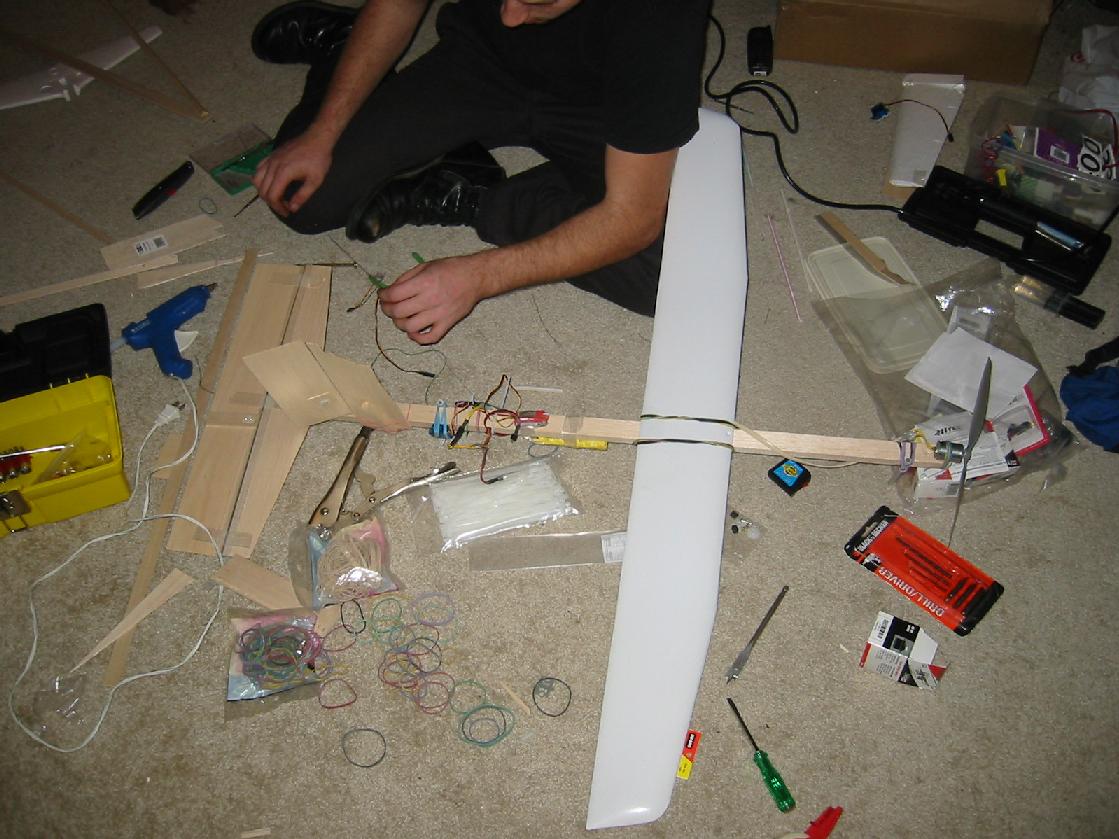
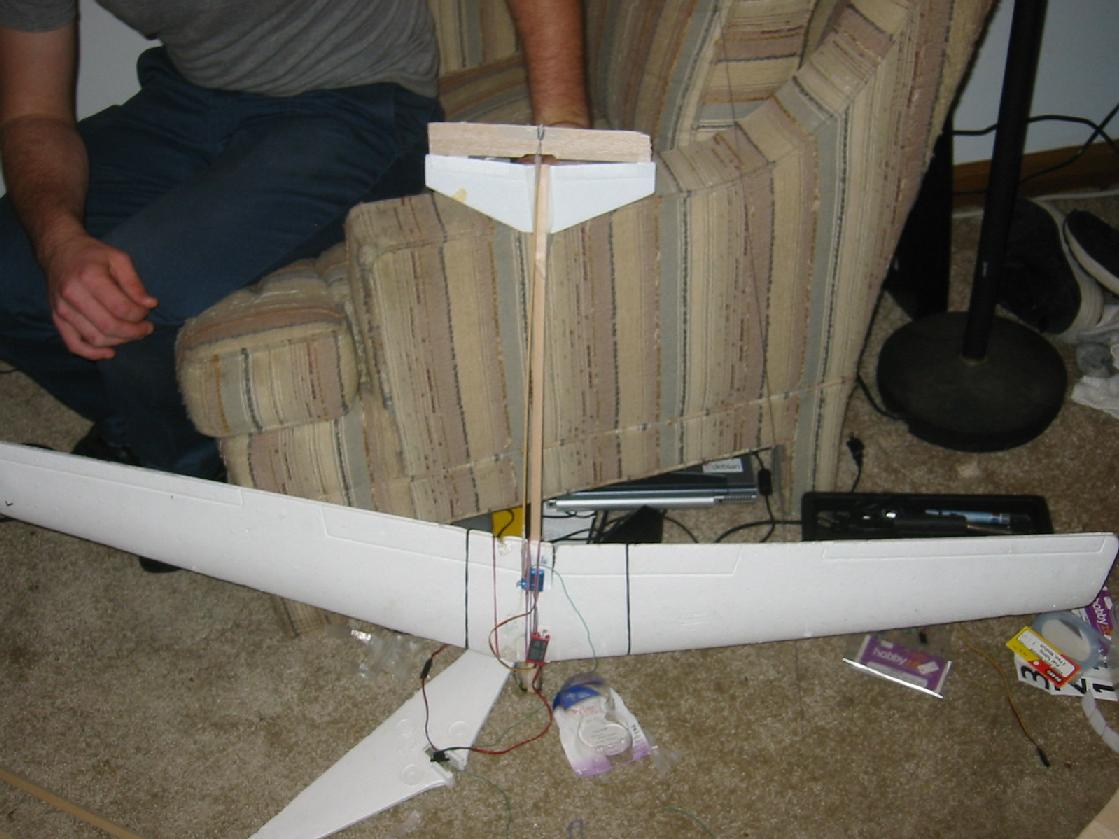
A few months ago Zack and I decided to build an airplane out of one of those cheap styrofoam gliders. So we finally got one, a Cox .049 2-stroke engine, and a radio/servo kit leftover from a previous (totaled) model.
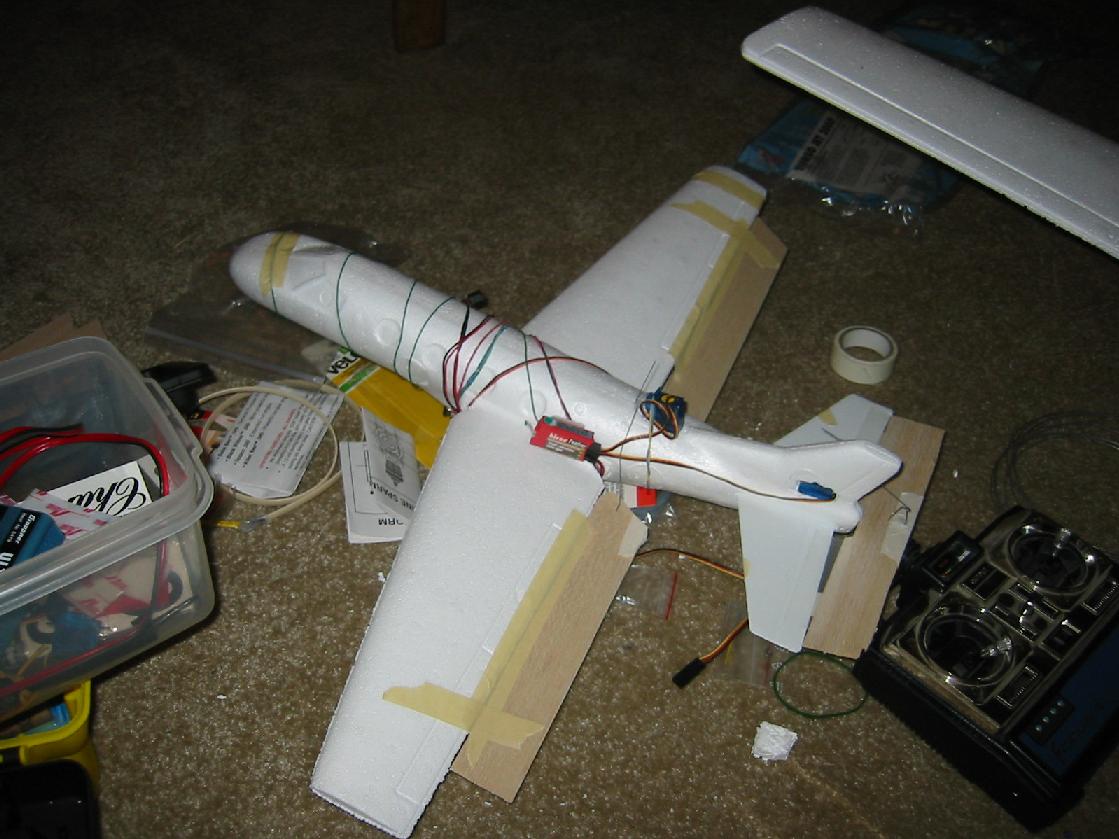
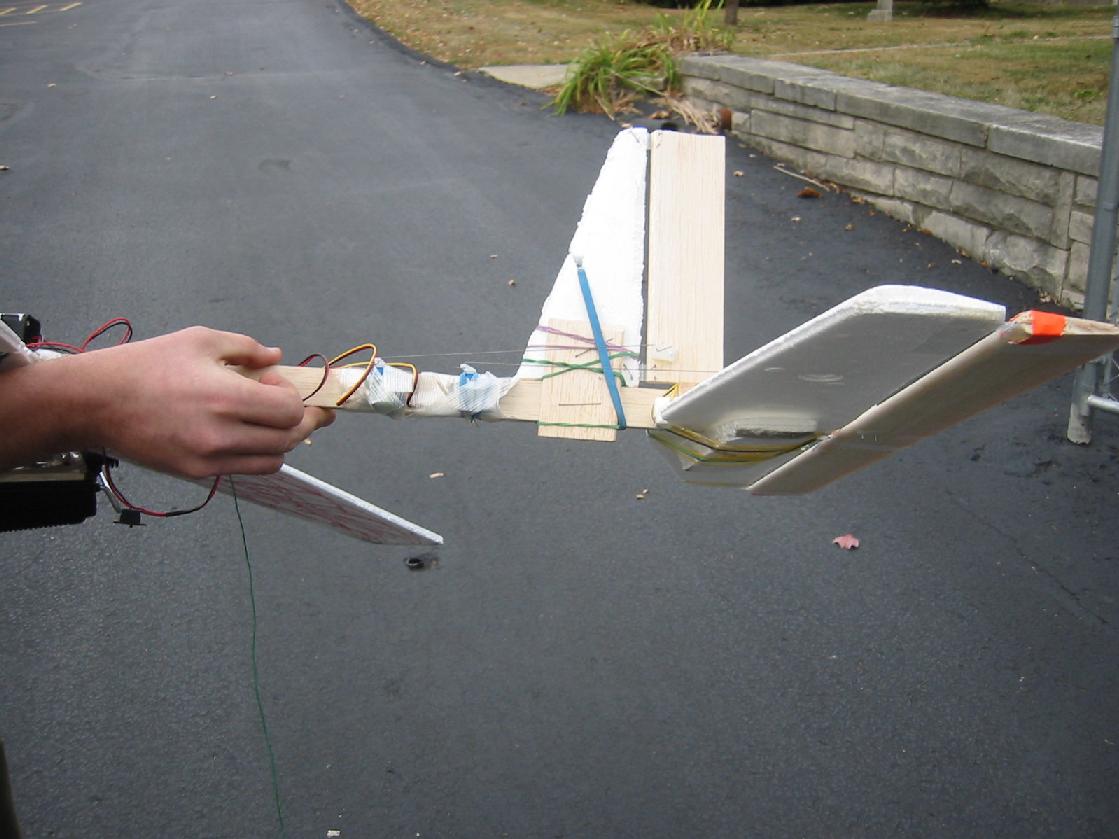
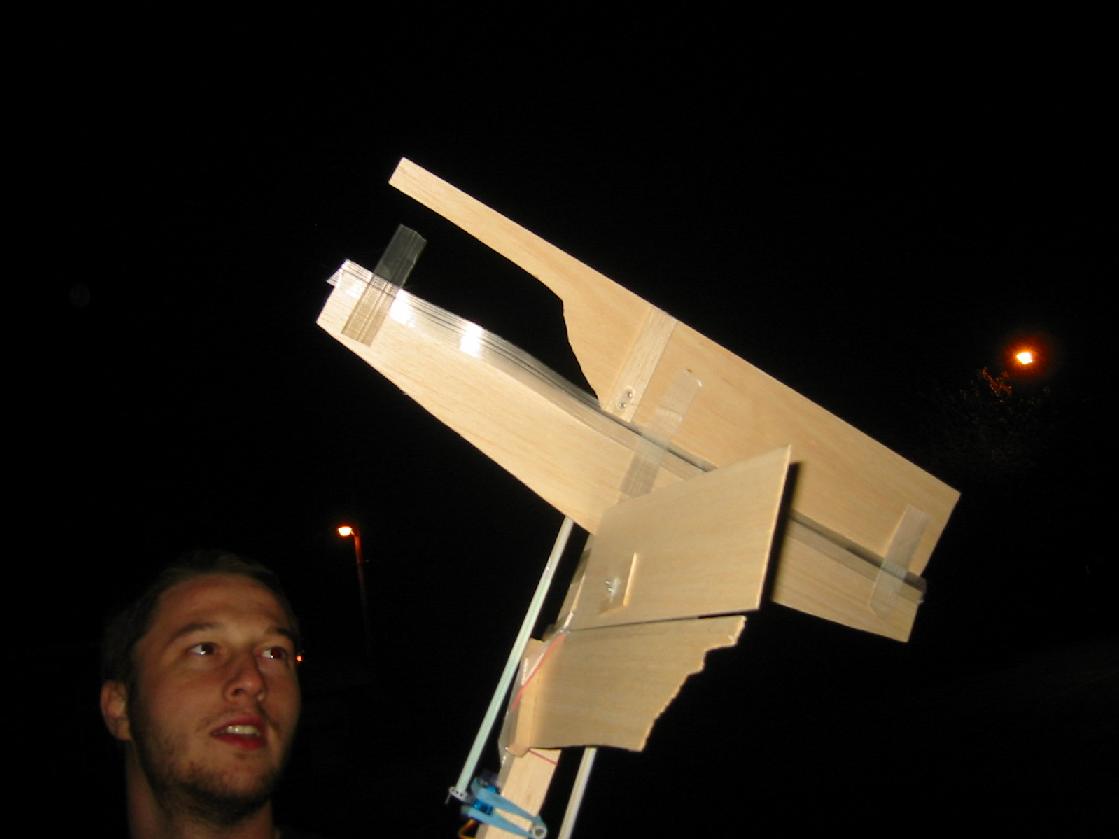
The first couple nights we attached very basic balsa control
surfaces:

We threw that around a parking lot until we were comfortable with the
controls and balance issues.
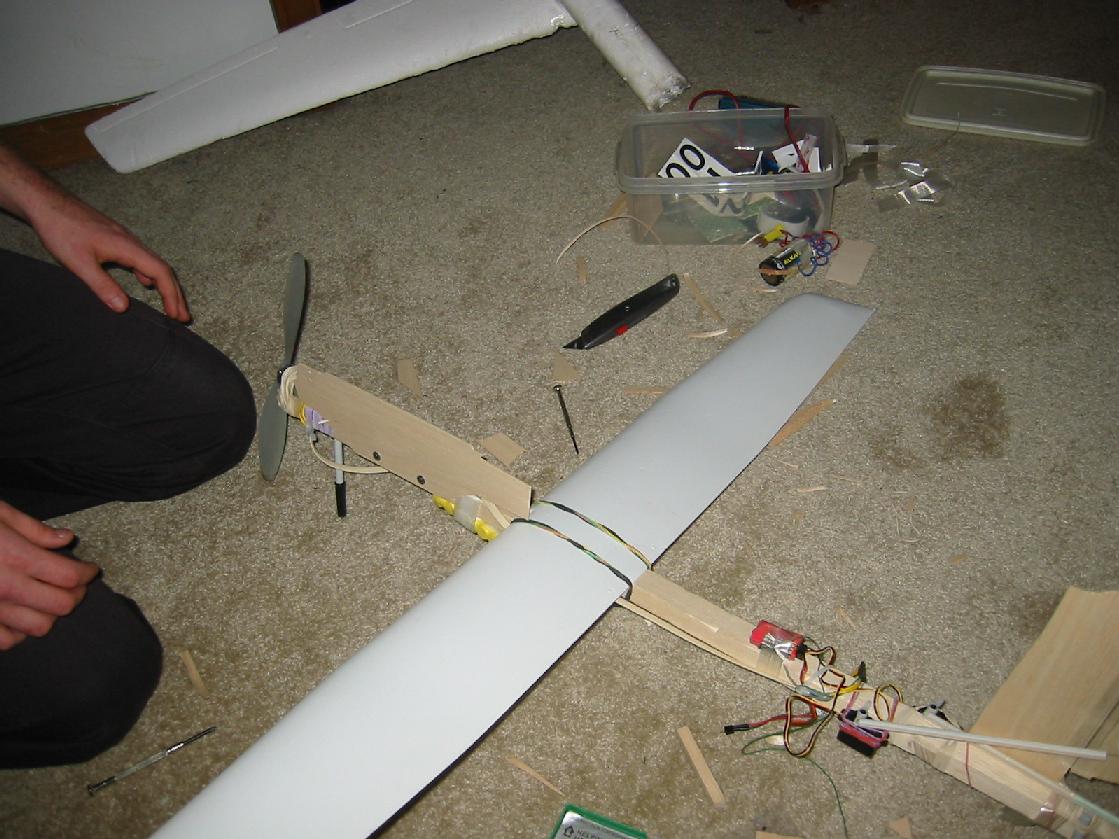
Then we added a little electric prop:

It was pretty disappointing, it was geared down for a much lighter
aircraft, and it would only extend the glide path a little. We also
broke one of the gears when we rammed it into the side of a church,
whoops.
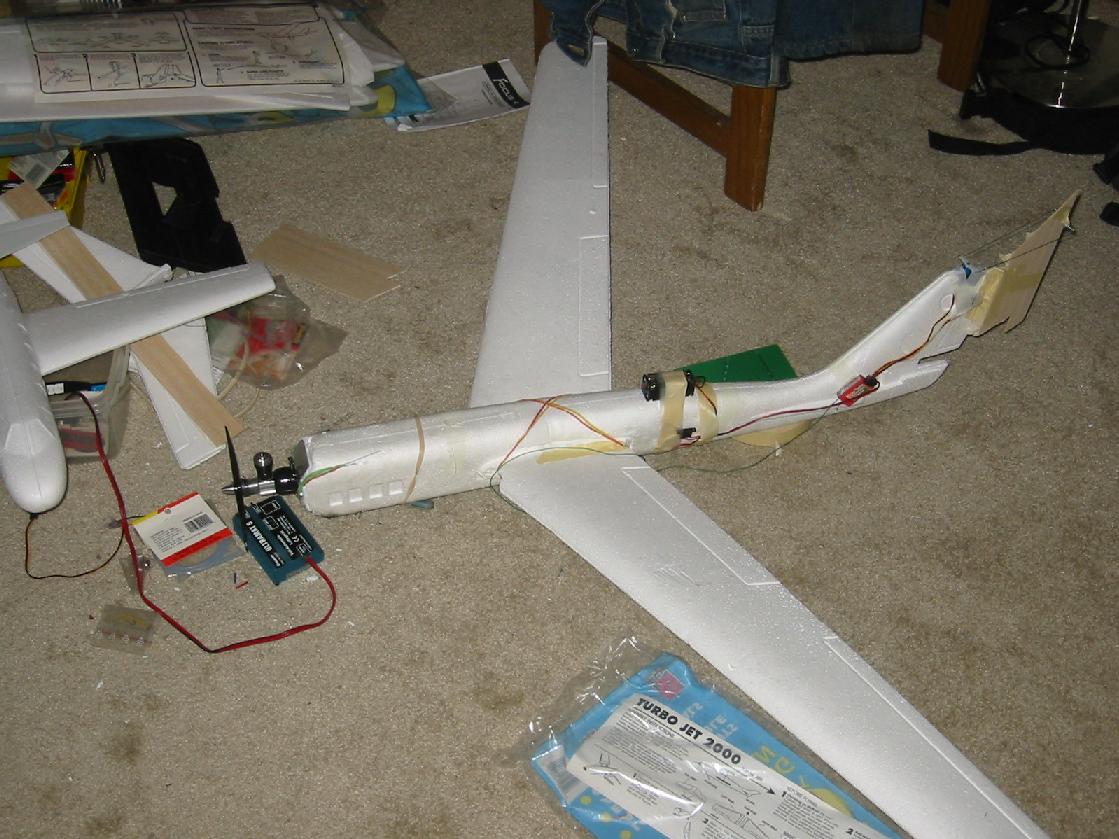
Then we attached the Cox .049, but we were still doing parking lot
flying, so it was just a test weight at first:
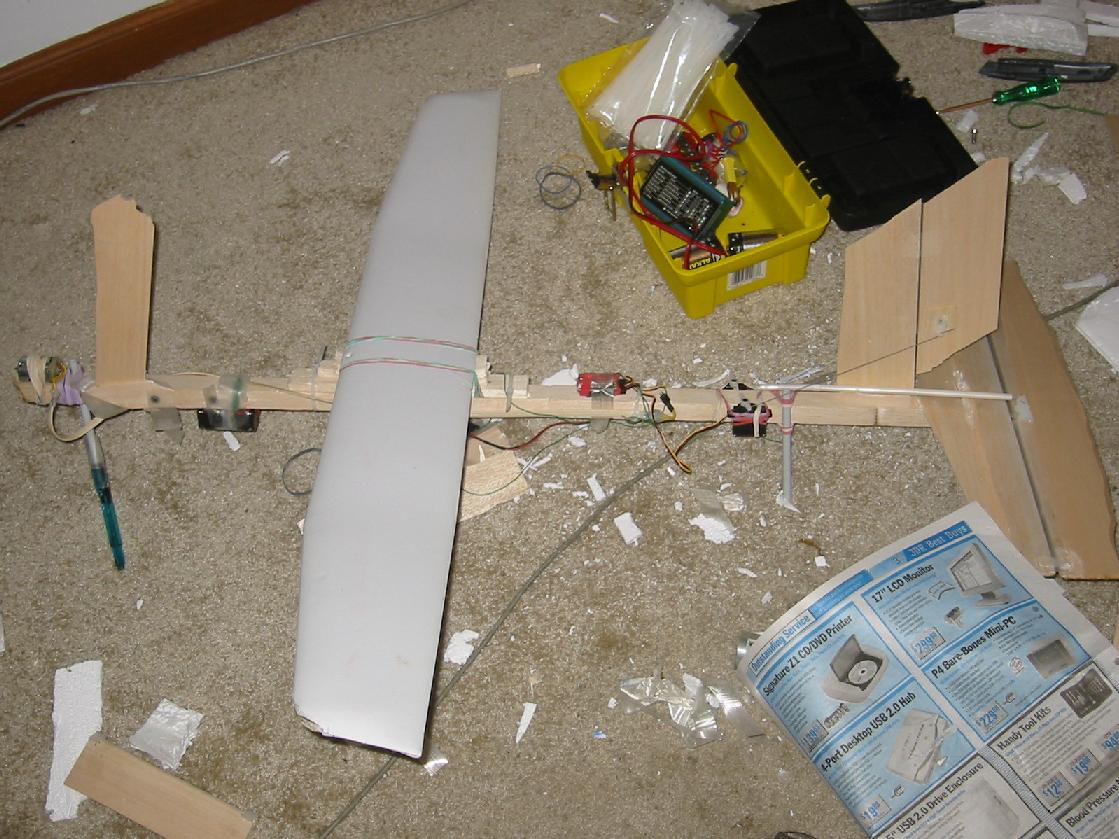
We snapped that plane in half (that's why we used the cheap foam
gliders), so I put the controls on a smaller plane:

It flew like a brick, but the control surfaces were very powerful. I
want to go back to that, try it with a motor on it, and see if it's
actually fun, if a bit touchy..
We went out to Zack dad's farm so we could fly with the Cox engine.
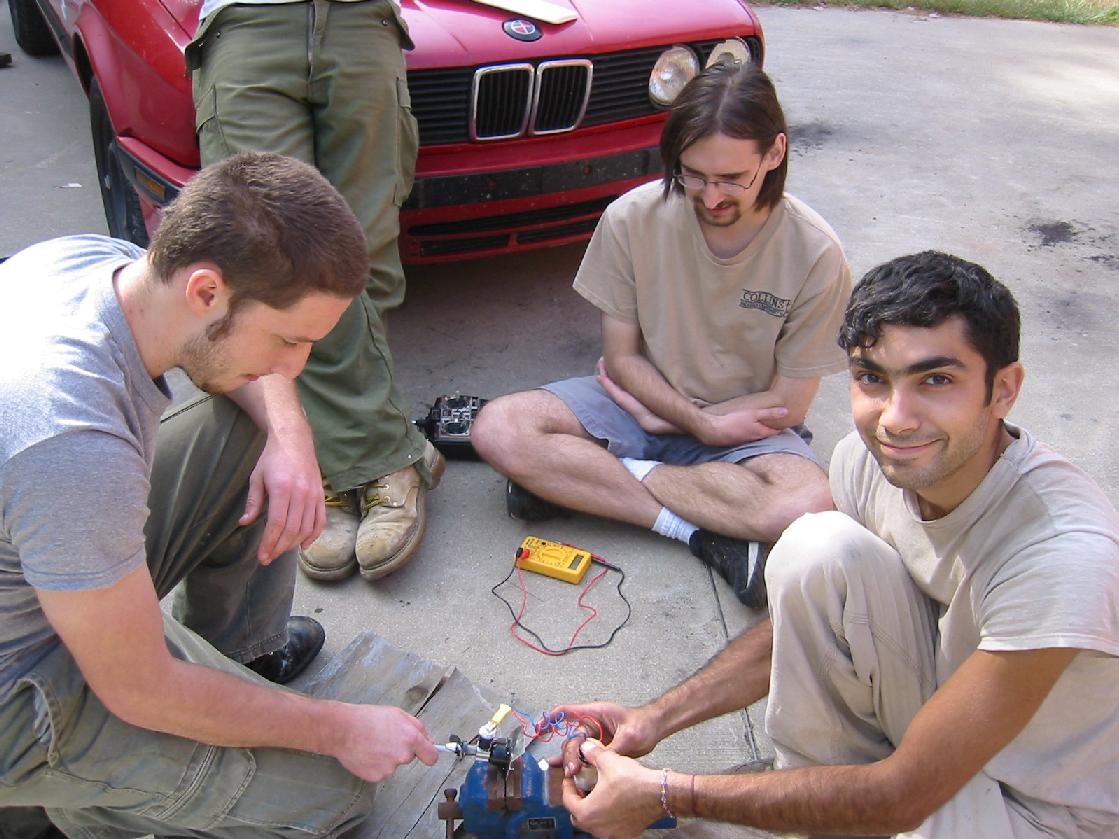
First order of business was learning how to start the Cox engine --
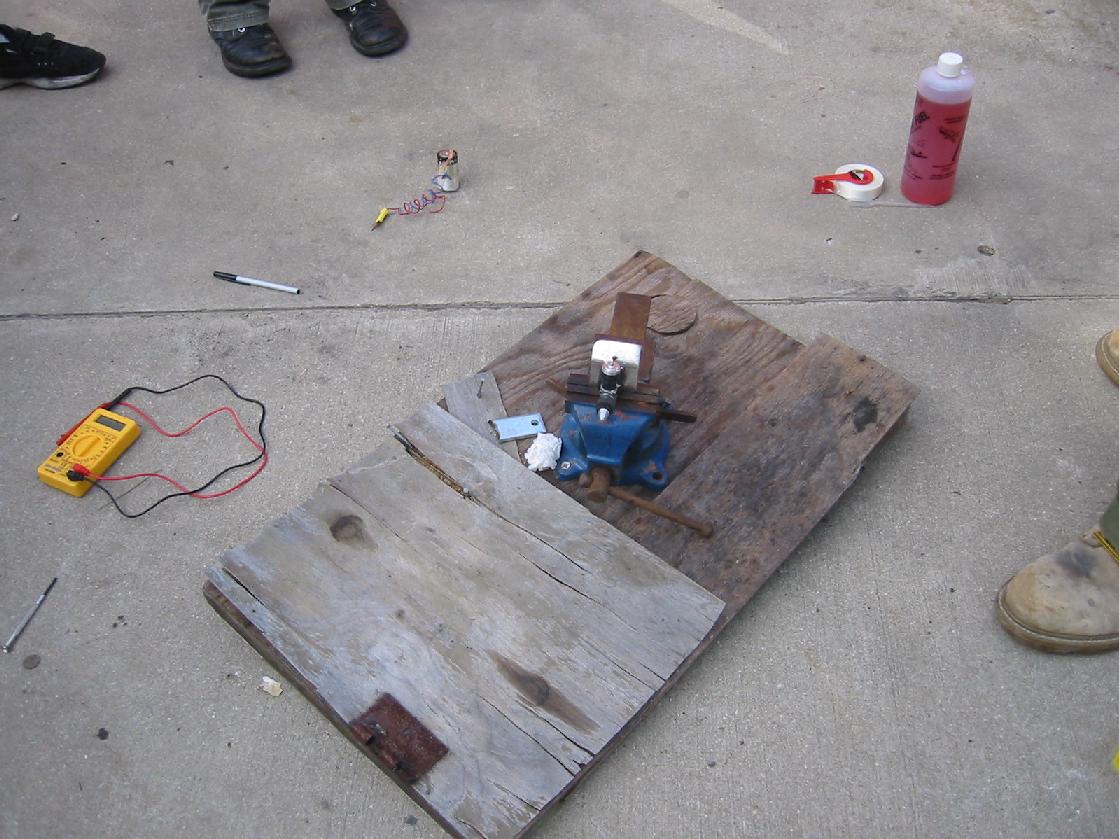
we'd had some disappointing experiments already:

But we got the hang of it and Zack and Kava became an unstoppable
starter team. You can't see the blades in this pic because they're
moving:
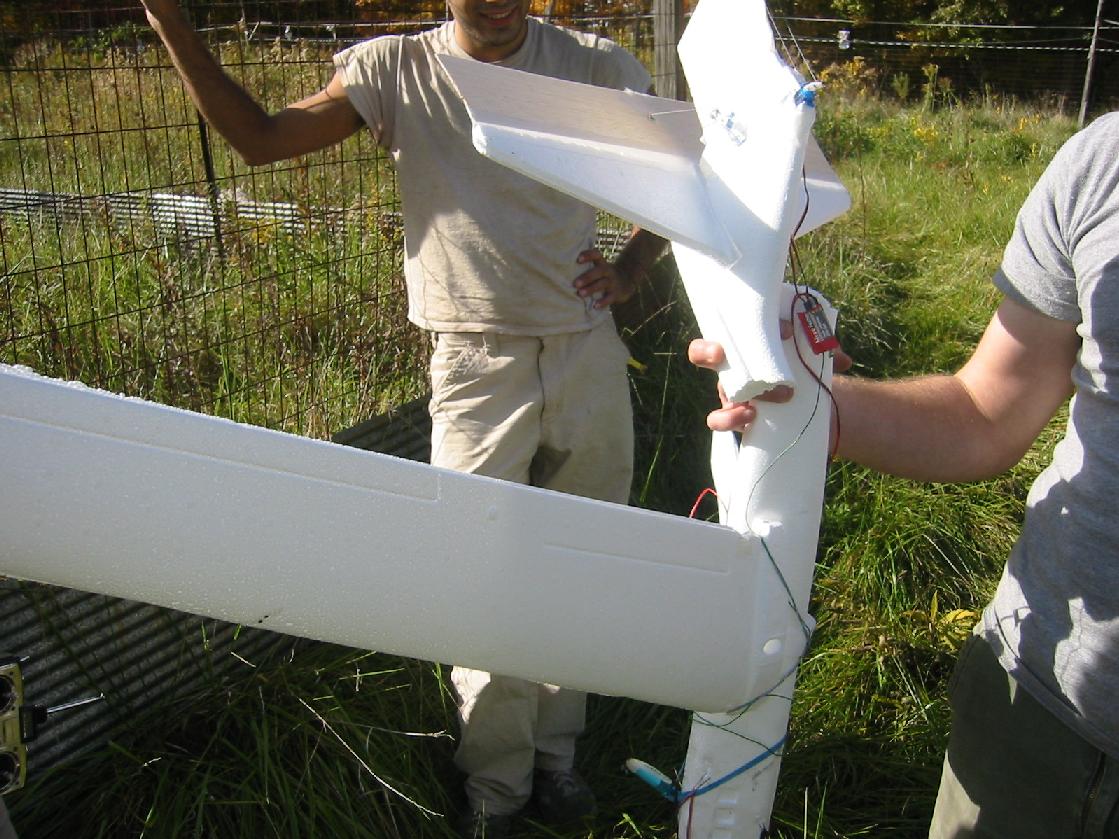
And this is how our first flight ended:
Zack taped a balsa splint on and the plane had two successful flights after that. It proved to be a very capable plane, very responsive, very overpowered, capable of flying into the mild wind we had, turning aggressively, and doing loops without any difficulty whatsoever. I turned out to be a fairly sketchy pilot, easily confused about which direction the plane was pointing, but it was still one of those magical experiences. Kava proved to be an able climber, but we eventually had to leave the plane in a tree overnight until we figured out how to get it out (32ft fiberglass ladder, 20ft metal pipe).
Anyone know where to get a cheap strong 40ft+ collapsable fiberglass prod?
Last week was one of those weeks where you discover that a single charge on the nicads can last through 3 models, because the models are so crapulent that they get scrapped (or scrap themselves) almost immediately. The lessons learned:
But this design proved quite stable, once we gave up on the
ailerons. We just need a bigger better motor (gas) and a field and it
will no doubt be quite the sleek flyer:

After a number of landings (it turns out the tail contacts first,
despite our best efforts):

We had a great set of flights today. While we were throwing around some of our more crazy experimental aircraft in the parking lot across from my apartment a while back, one of my neighbors walked up. His name is Matt and he is an airplane mechanic at the local airport. And he's building a really cool scale biplane. So today when we are burning in our new motor he shows up and decides to go out to the farm with us. He coached us and, following his example, we had about 5 successful flights, with very few amazing crashes.
First, here's an experimental "front rudder" or "keel" we tried to
prevent it from drifting to the side:

Here's another experimental stage. We built a huge flat wing out
of our first set of styrofoam wings. It appear to be indestructible,
so we put the first tail we found on the floor on it. It wasn't
nearly powerful enough to control it, but it was neat to have such a
light and bare model as a proof of concept:

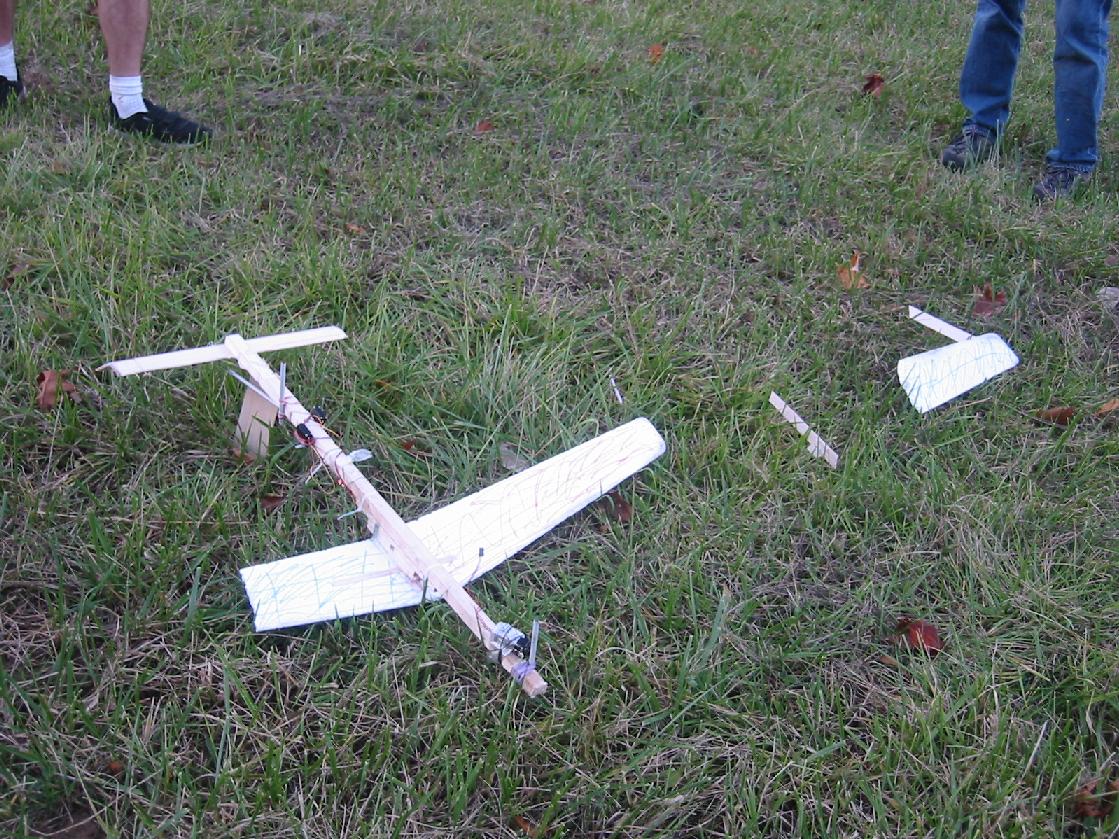
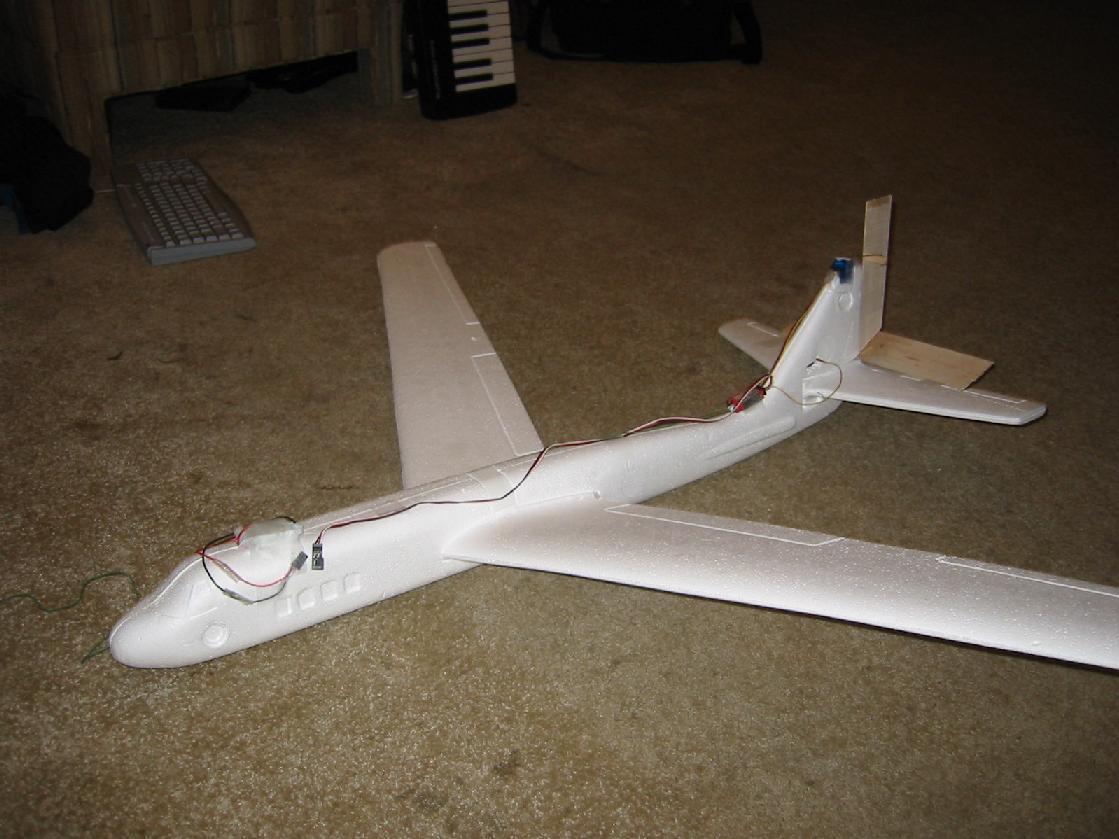
At the end of last night's experimentation, we came up with this
plane, shown here with an electric motor for parking lot flying:

It was mostly uneventful to outfit that thing with a gas motor and throw it at the field. The first 3 flights were exciting (and nearly identical). It rolled to the left...hard, so it followed an arc up, then smashed exactly nose-first into the ground. No damage, luckily. It was kind of distressing when we discovered we'd just hooked the rudder control up backwards, so when the pilot tried to correct for the roll, he just made it worse.
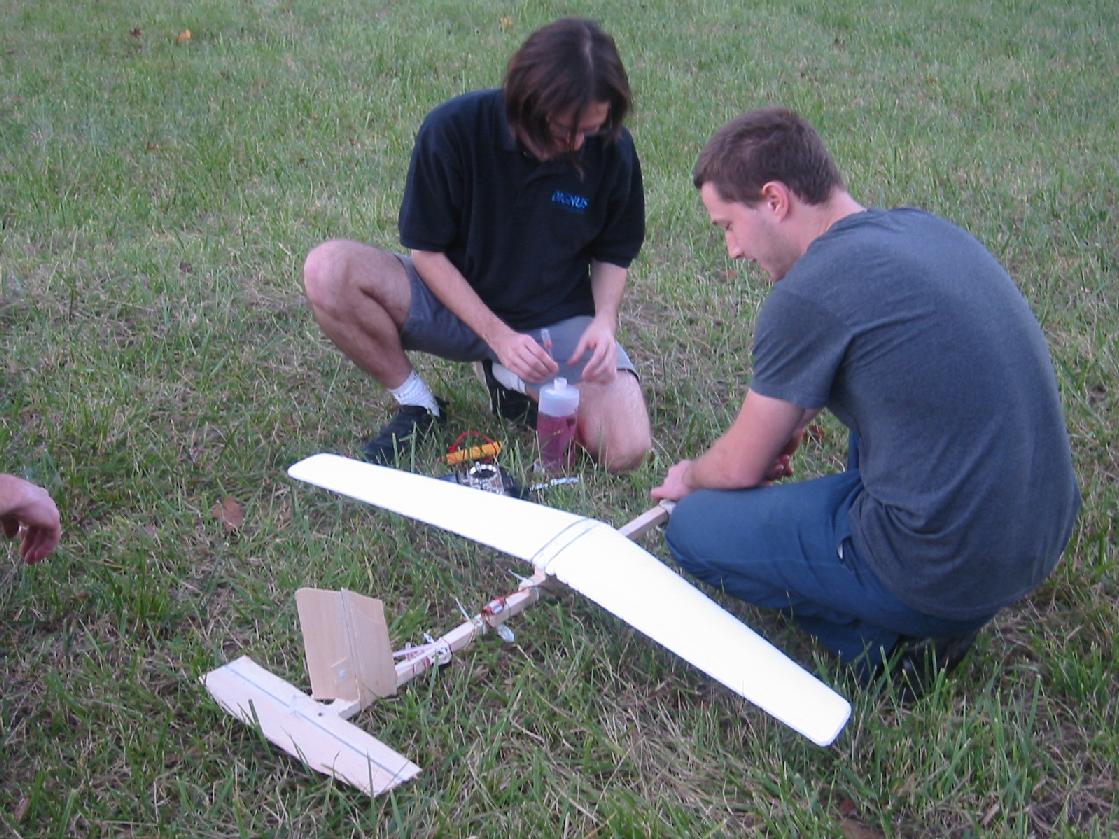
Here it is about ready to take off at the field today:

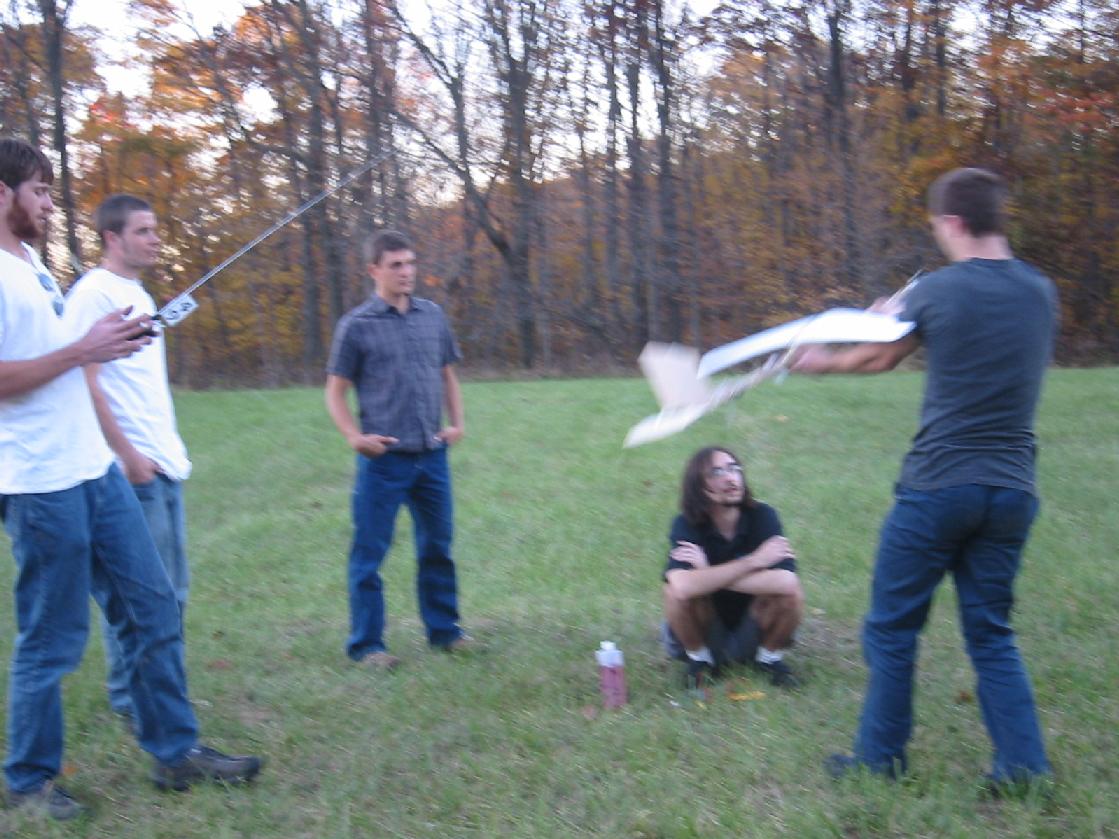
Being thrown:

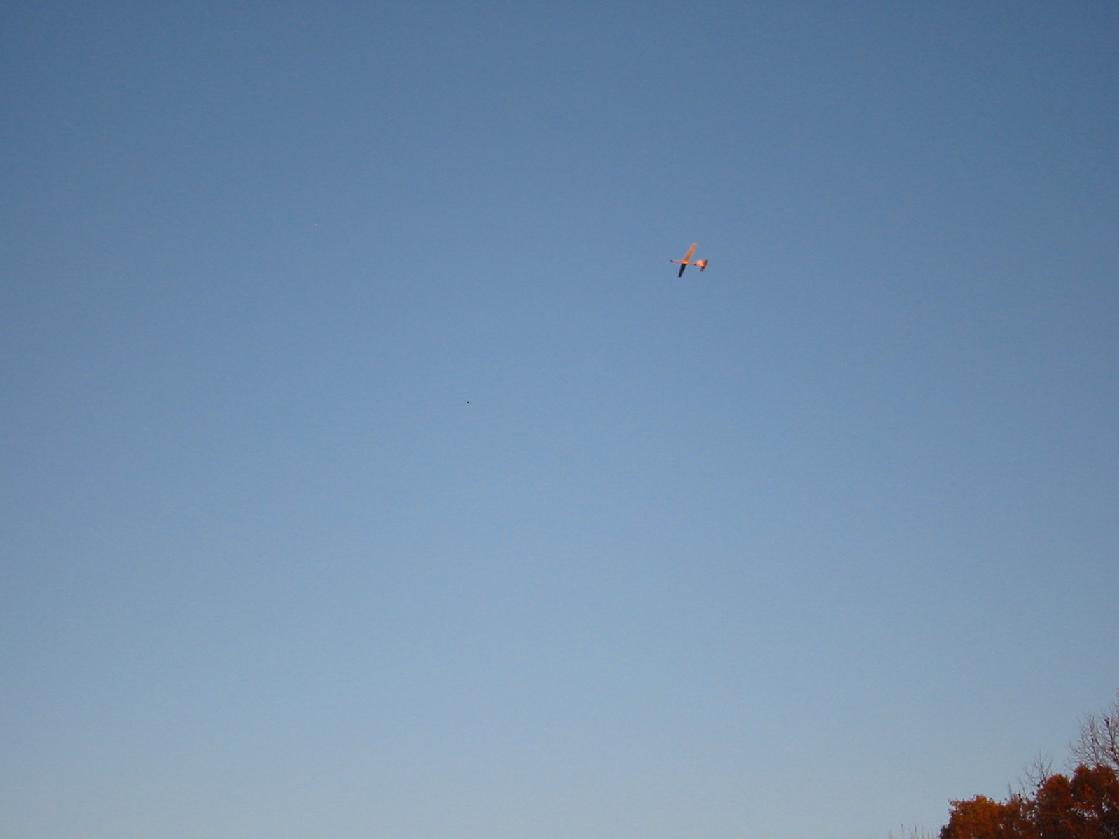
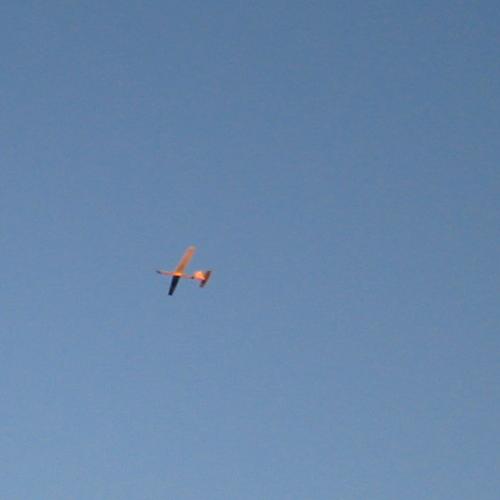
In flight:
zoomed in
We got some VIDEO of that flight. Click here for video.
The first flights were all with some relatively high quality wings we'd
purchased from the hobby shop that had been intended as replacements
for a cheap kit. They were very light and also about as small as we
really wanted to do with this motor. After we did a little bit of
damage (repairable) to their leading edge in a tree landing, we
decided to go ahead and throw on the flat wings we had assembled the
night before. They seemed to fly pretty well, but the pilot lost
orientation (or maybe one of the control lines snagged on one of
several protrusions?) and the plane did a nose dive from above the tree line.
The motor was burried two inches deep into the dirt:

We had previously considered that wing unbreakable:

It was getting dark and it would have taken a good 15 minutes to repair that damage, so we went ahead and called it a night.
The biggest things we learned:
I've been putting a half-assed effort towards putting together a very light electric plane. I've got a joke of a motor with a small prop that looks like it was designed for rubber power, and a too heavy NiCad battery pack and some three and a half foot wings (about 1.3 sq ft), and (for now) rudder/elevator control. It flew level for a while, but rudder impulses were so powerful they rotated the entire body of the plane relative to the wing (which was held on by a single rubber band). I really like the idea of using a totally underpowered super light and tiny airplane. I built a primitive balance and it seems to weigh less than 9oz, making for a very light wing loading (about 7 oz per sq ft). Most sailplanes have a much wider wingspan (for a better "aspect ratio" -- thinner wings) but also weigh much more.
Here is my light electric beside its wing (it broke the rubber
band)...not sure what happened to the elevator.
I'd like to eventually put a refit brushless CD-ROM motor and a couple of lighter Li-ion batteries, for a totally ridiculous amount of power in the absolute lightest package possible. But to do that I want to build my own brushless motor controller so I can get a better understanding of what's going on, and that will take time and effort.
I also bought kind of a flying "zip zap" (the cheapest smallest r/c car ever). It has barely a foot wingspan, and is made out of mostly a single piece of very durable foam. It has two tiny motors and steers like a tank (putting the stick to the side cuts one of the motors). It was amusing for about two hours.
We broke the props, so Zack fashioned some balsa ones that almost
worked:
I've also been assembling my kit plane with Zack. It is a few carbon fiber rods connected with kevlar and cyanoacrylate (super glue) and shaped basically like a kite. It will be covered and fly like a big flying wing with huge elevons. It's gonna weigh about 8oz and with the huge wing surface it should be pretty fun.
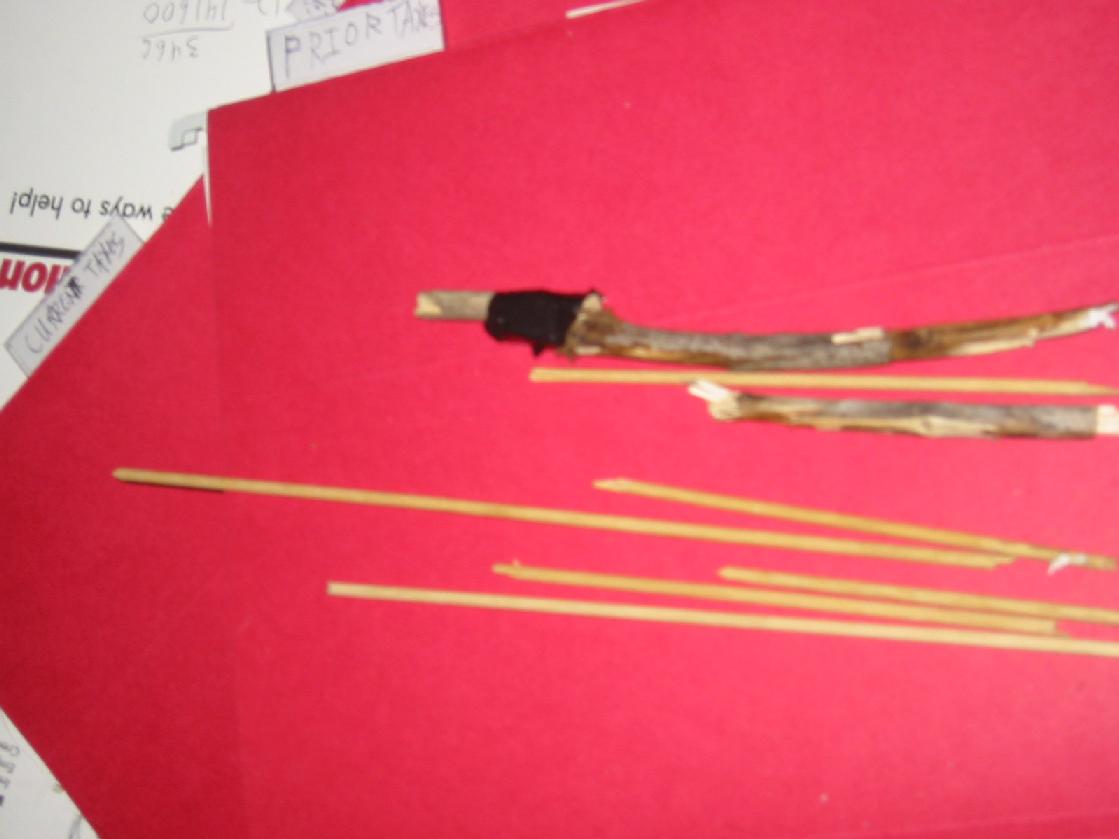
Here's the beginning of the assembly, most of the carbon fiber
frame:
My dad explained how the signal from the radio works -- it is essentially a pulse train (encoded in an FM signal), one pulse per servo, and the length of the pulse determines the servo position, between about 0.5 and 1.5ms, with a longer pause before the first servo to keep it in sync. I was thinking maybe I could hook up a microcontroller to my radio and give it computerized mixing functionalities, and ghost channels (I could get a 6 channel receiver and have the computer control flaps from a switch or something). With just a little fiddling with my oscilloscope and a websearch it was easy to see the pulse train being output at 0/+10V levels from the trainer port on my transmitter. Hooked a resistor from the output to its input, and flicked the trainer switch and it picked up its own signal -- should be really easy to work with. The trainer connector even gives me +10V from the batteries for power.
I did some reading online and it looks like the magic wing loading for small (1-meter) sailplanes is in the 3-5oz/sqft range. I've got these 43" wings I've been using that weigh by themselves about 2.5oz and are about 1.3sqft. So I put together the lightest flight pack out of the equipment I have.. 2x HiTec HS-55 servos (rudder / elevator), 4-channel HiTec feather receiver, and I built a battery pack out of 4x 180mAh nicads I had (4.8V) sitting around for a computer project.
Total weight: about 5oz
Wing loading: 3.9oz/sqft

This is the 1.2oz battery pack I made:
Zack came over and we gave it a toss once the battery had charged a bit. It was perhaps promising but on impact the front half of the stick snapped clean off. We were trying a rubber band impromptu way to reattach it when the back half of the stick snapped clean off. What happened was we built a plane out of a 3/4" square stick, and it was indestructible, so we built one out of a 1/2" square stick, and it at least held up to a couple glide tests, so I built one out of 1/4" square balsa, and it snapped on its first flight. There's optimism for you.
But we were undaunted and used rubberband hacks to kind of hold it together. It was a joke in flight, whenever it would jolt at all, the rubber bands would let the stick with the battery on it swing far off to the side. But eventually we just didn't care and Zack tried a frisbee launch that was actually a lot of fun...I could detect that we had control. Not enough to do anything with, at least not with my reflexes, but it was neat to think of it as just kind of a variable aerodynamic object even though it was operating well outside of conventional straight-line flight.
But that could only be fun for about 5 minutes, so we went back inside and thought a bit. Zack wanted to use a big light piece of foam as a fuz, so he was demonstrating how strong it was when it broke in two. So we just reached in the closet for more foam. Zack picked up like twenty of these 1'x4' pieces of posterboard-coated foam from a copy shop's dumpster. Not really appropriate for a fuz, but we've been wanting to make a flying wing for a while. Once we got real drunk and gave one very inexact polyhedral and put a weight in the nose (jammed my 'helping hand's alligator clips straight through it), and it was a grand old time to toss around the yard.
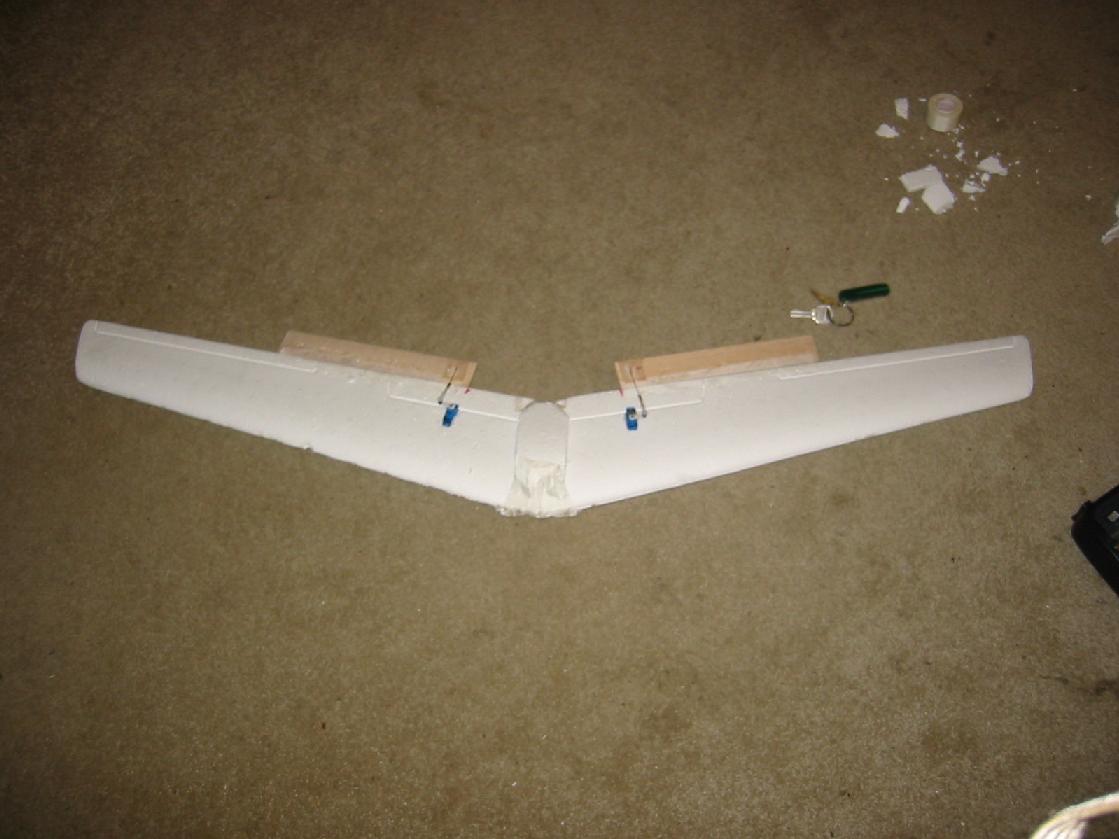
So this is what we came up with... We never decided if it was meant
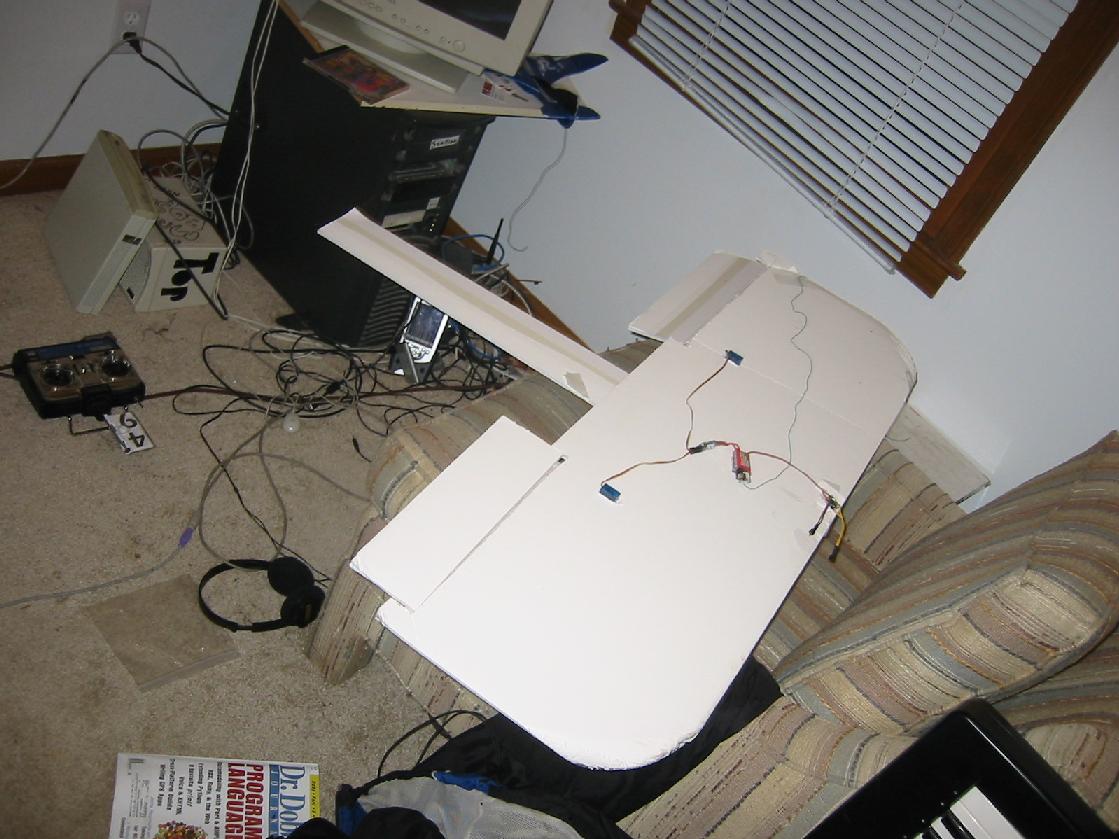
to fly "inverted" or not, so... Let's call this the bottom:

And let's call this the top:

Note the tiny tiny elevons on this version. We'd never flown any sort of elevon or flying wing airplane before, so this was a big experiment.
When I hooked up an elevon mixer to the receiver, I found the same bizarre problem that had haunted us earlier...when I plugged it in, suddenly the receiver stopped working, and even when I unplugged it the receiver wouldn't drive a servo directly. I was very puzzled by this, but eventually figured it out: every time I hook up the elevon mixer I stupidly put it on wrong the receiver channel (basically I turn the thing upside down), and from then I'm totally confused. Way dumb, eh?
So after a couple flights with absolutely no pitch stability, even
after we hung a 2oz pocket knife (because it had a convenient belt clip) on the
front of it, we decided something had to change. We noticed the
elevons could actually fight some of the poor pitch behaviour, so
bigger elevons was our first decision:
.
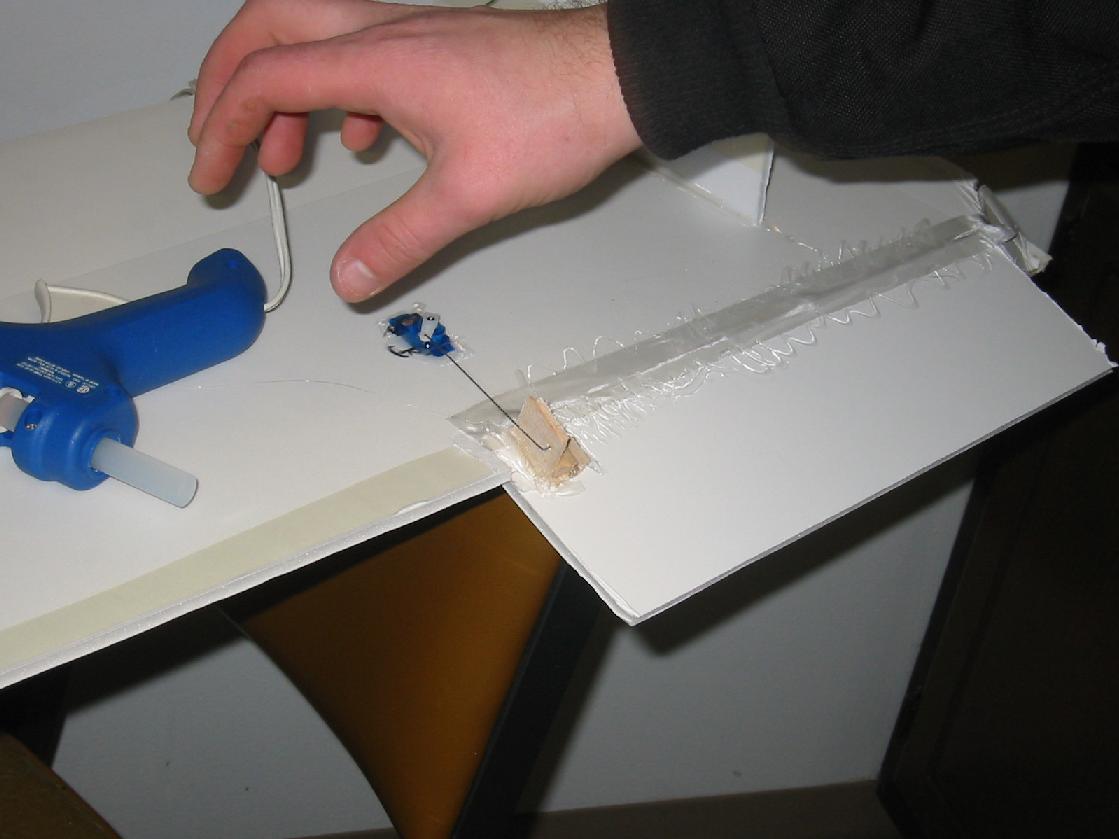
I weighed a glue stick and it's only about half an ounce so we sunk about three into this aircraft. It made very strong joints for those vertical stabilizers. We also found that the cloth medical tape we were using for elevon hinges really soaks up hot melt glue well and sticks to the posterboard great, so Zack put it all over the tape -- these may be our strongest control surfaces ever. You can really see how it's piled on in the above picture.
We also had had luck earlier taking just a normal reasonably-sized
pair of wings and adding just a long strip of balsa hanging off the
back of them. Just throwing the wing around, it seemed pretty stable.
So we also did the same thing here, giving it a bit of a tail:
The end result wasn't really flyable. Part of the trouble, though, is that my tiny battery pack never got a chance to charge, so it gave out shortly after we went outside. The bigger batteries, though the weight wasn't really a problem, didn't get the real tape treatment they required.
Overall our experiences with this flying wing reminds me of a couple months ago when we were first putting wings on sticks, before we really started caring too much about center of gravity and stuff. I don't know any rules of thumb for flying wings, and it's not quite as simple as with the smaller wings we've used. They are as likely to spin up as to spin down, it's kind of obnoxious. We'll have to try again tomorrow.
Today Zack said, "do we have any more of those foam gliders?"
So I just put
some control surfaces on one.

Really, we've done exactly this before,
only the mindset has changed. The intention is different, this one
isn't intended to have a motor. Which doesn't really change anything
because we threw around all of the motor-destined ones without a motor
first just to see what we were doing. The real change is
the factors that we are now aware of.
So here I have collected some specs about the airplane. Pretend it's a cool physics class project. Its got wings with "aggressive" dihedral (I don't have a protractor) and aggressive delta or back sweep (which has basically the same effect), so it is very stable. The center of gravity when it is assembled unmodified is about one centimeter from the back of the wings where they touch the airplane. The wings have a "root chord" (from the leading edge to the trailing edge of the wing where it touches the fuselage) of 7 inches, and are tapered to a tip chord of 3.5 inches. The wings are about 26" from fuselage to tip, for a total area of about 136 sq in per wing, or about 1.9 sq ft overall. They are cambered, but not as severely as the wings I have been using (those are actually concave on the bottom, this is just flat).
I plugged in the root and tip chords into a formula and found the "mean aerodynamic chord" to be about 5.4 inches, which I think means that the wing acts overall about the same as a rectangular 5.4"x26" wing (plus whatever advantages tapering gives us), which brings us up to 1.95 sq ft. Not a big difference.
Weights:
| 4.5oz | foam glider |
| 0.5oz | hitec 4-channel feather receiver |
| 0.5oz x 2 | HS-55 servos (rudder/elevator) |
| 1oz | 180mAh 4.8V NiCad battery |
| 0.5oz | leftover (tape, balsa, wires, superglue) |
| 7.5oz | total |
Not quite as light as the balsa toothpick we broke last weekend, but it has bigger wings, so it is still only about 4oz/sq ft, which is close enough to the target 3oz/sq ft. To maintain the existing center of gravity, I have about 1.5oz of electronics at the tail of the plane, so I moved the 1oz battery forward until it balanced about where it should.
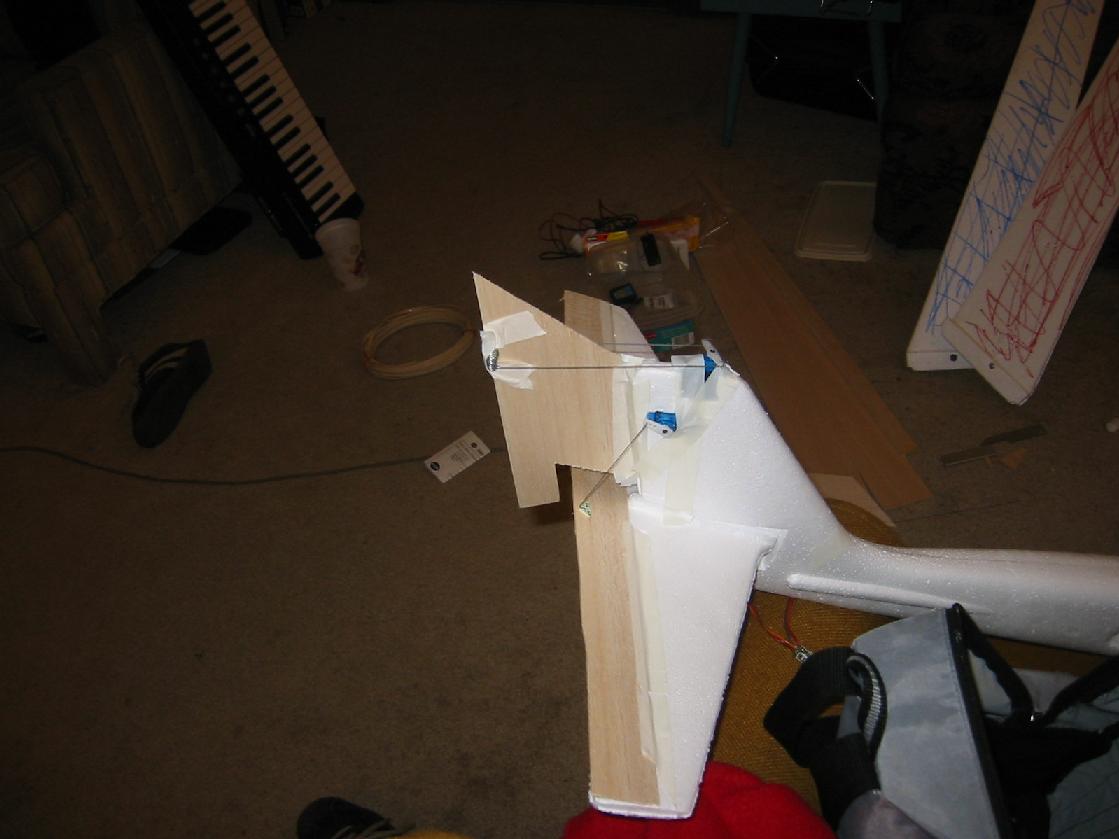
The greatest part about building this was we already learned from all the old mistakes with these foam planes. We already know the best way to mount servos on the tail and stuff like that, so this is all pretty much "on the first try." There's no residue from a dozen different things being taped to this plane and taken off, no huge glue puddles or useless rubber bands scattered all over it.
So I put it all together, trimmed it in my livingroom, and gave it
a toss:

(yeah it can meet the wall without damage)
It has one weird characteristic I can feel just playing with it. When the elevator is full down, if I release the stick and allow it to return to center immediately, it makes the whole plane vibrate just a little bit. A lot more than any other control surface I've ever seen, but probably not nearly enough to matter. I guess something bends a little bit when the servo is at full throw?
I took it out to the church parking lot and gave it about a dozen tosses. It's really fun, as gliders go. On the third toss (just a hand toss from ground level, with one hand on the radio) I was able to get it pretty much all the way across the parking lot, rivalling our previous best that was achieved with one guy standing on top of a big concrete sign about 12 feet in the air. Due to the innate stability of these foam planes (and perhaps due to some reflexes I'm slowly building), every single landing was a perfect level belly landing, even after I started just tossing it twenty feet straight up to give it a little more range, it never felt out of control. Very predictable and controllable.
So tomorrow I think I'm gonna launch it at a nearby park with a huge hill, see if I can catch some thermals (hah right). As I see it, in terms of most specifications, this plane is about the same as a lot of the professionally produced gliders in this class, so I expect that it should be capable of some fun flight characteristics. I don't know much about aerodynamics, though, it might have excessive drag or something. I do know that the "aspect ratio" (span / chord) of the wings is about 10, while good glider wings have an aspect ratio more like 20, which results in a better lift/drag ratio. On the other hand, the aspect ratio effects are not linear, so 20 is a lot closer to 10 than 10 is to 3 (it makes sense if you look at some graphs).
Well we launched it, and we found that this foam gets brittle when it's cold outside:

It's finally warm enough to think about going outside, so yesterday we put back together our basic stick plane and gave it a couple tosses. But we forgot the real reason that we don't fly much during winter: wind. The plane was perhaps a bit underpowered after the addition of a fuel tank, but the wind was fatal. So without further adieu, enjoy a video (8MB).
Today Zack reapproached making a straight wing out of the foam gliders (which, in their natural state, have really severe dihedral and back sweep). The one we built in the past worked alright but was a little bit too flexible for the ailerons we had and dramatically ripped themselves apart in midair. The foam is very strong and the wood and epoxy that we used in the center part to hold the two halves together were also strong, but the joint where the inflexible wood ment the very flexible foam went the way of the dodo. So this time he ran a balsa spar almost the full length of the wing, and we used the less brittle hot melt glue instead of epoxy.
He also used a curious wing mounting technique for another one of
our stick planes (this time, a glider, but we'll probably add a .049
to it tomorrow):


I was skeptical of the tiny control surfaces, but the elevator actually proved plenty powerful (probably because it had such a long lever arm). The rudder was almost but not quite useless though -- it probably didn't have as clear a 'pivot point' to take advantage of the lever arm.
We threw that around the parking lot a bit and even though there was a light wind, it was obviously a pretty capable aircraft. Finally an inverted landing took off the rudder.
In the process of putting this together, I finally broke a servo gear. One of the tiny HS-55 servos was sounding a little louder than usual last weekend, and this weekend when I was trying to gently move it to a different position so I could get access to something, and it jammed. Moments later the servo arm was spinning free of the motor. We took it apart and determined exactly which gear it was -- only one tooth was gone, but it didn't matter, the moment the servo got to that gear, we lost control of the arm. Even if we didn't need control in that range, every visit to that spot on the gear destroyed the trim. I just ordered a replacement set of gears, it's only $5.
I also ordered a Magnum XL-15 engine, which is about 3x as big as what we've been using (but only about 6oz, still). All together, this will probably more than double the weight of our basic stick plane, but it should provide enough extra power that I'm frankly not too worried about that. But it will probably fly a lot faster (unless we start building bigger wings), so it should be exciting.
When I was cleaning up I realized what I'd turned the corner of the
bedroom into:

I clearly have the bestest girlfriend ever.
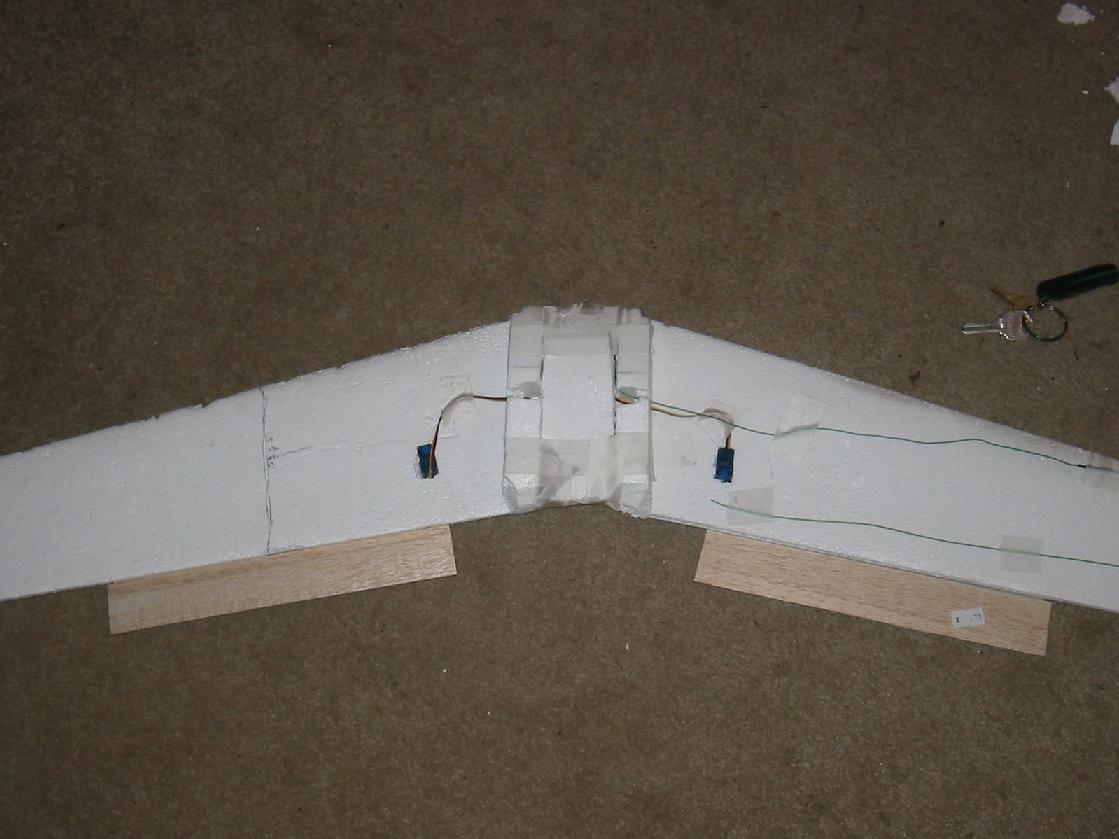
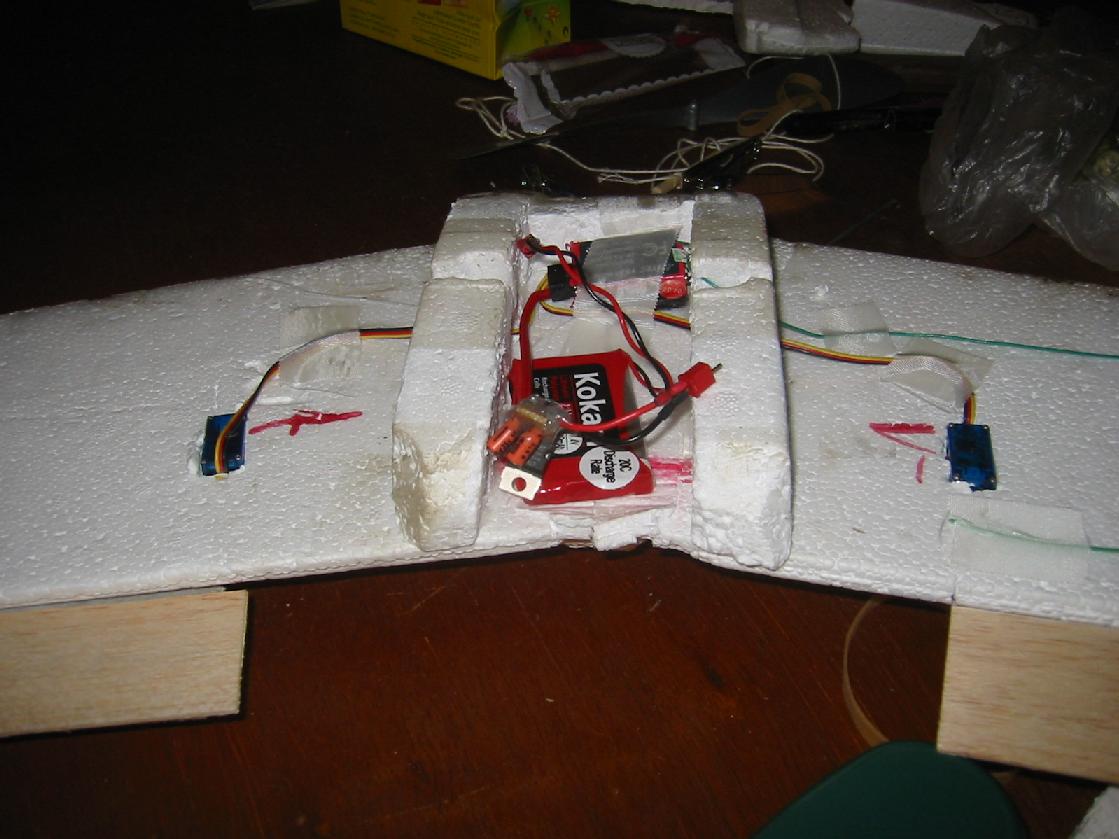
Today we took that same plane from yesterday and added servos inside of the wings (just cut a hole straight through the foam) to control ailerons. We also left off the rudder, figuring ailerons would do us. On the bench it worked great and trimmed out well, but when we put it to work in glide tests we ran into a few problems.
The first obvious problem is that I used the battery extension cable to make the aileron Y cable, so we had to put the battery under the wing, and almost an ounce of ballast in the front to get the center of gravity about right. This plus the extra servo added enough weight that the thing didn't glide long enough to get a satisfactory understanding of its flight characteristics.
The second obvious problem is a little more obvious in hindsight but was quite astonishing in person. The thing had a tendency towards extreme instability. Even moreso than our other no-dihedral projects. It would go into a flat spin at the slightest provocation. Duh, when we decided to leave off the rudder nobody ever bothered to reattach the fixed vertical stabilizer! We ran back inside and glued on some sheet balsa real quick, and it improved, but the whole thing was still a little unstable, and the wind, and etc., and I did a knife edge landing and managed to break off the last 9 inches of one of the wings.
A little discouraged that we'd almost demolished our plane during simple glide tests, we switched for the moment back to old faithful: walmart-style foam gliders (we actually buy ours from The Treasure Chest, a wonderful family-owned hobby shop downtown). I had one sitting around pretty much built (not that that takes much), so we just slapped some servos on it and it was ready to fly in about 15 minutes. Instead of the typical plastic U thing to hold the wing on, we used just two rubber bands, and that actually worked out wonderfully.
So we took it to the local park with the big hill and had a great time with it. The winds were unpredictable but mild enough that it mostly didn't matter. The only control issue was that the rudder didn't have quite the assertiveness that I wanted when messing with a strong wind. A couple times we caught the wind just right and actually rode it for maybe 5-10 feet of lift, but not enough to convert that into speed to do a 180 and ride it more. You sure get a lot of exercise running up and down a hill chasing a glider!
The process of learning is quite pleasant. Zack was throwing the glider up the hill towards me, and right before he tossed it I tried to work it out in my head "it's coming towards you, your turning is reversed" but it actually messed me up, already my idea in my head was naturally reversed because I was thinking "in the pilot seat." Now that I've spent some time with an r/c simulator, even after years of normal simulators, r/c perspective feels much more natural, especially when you are playing with ground effects and tight turns and slope drafts. Much easier to keep your relative-to-ground orientation from outside! Another great learning experience was knowing when we're in lift. I'd read from some thermaling pages that you very quickly gain an idea for whether or not your plane is in lift. Even from hours of sims I hadn't really gotten that reflexive feel, but watching the plane on the hill, you could really tell when you got uncommanded lift.
One thing that was a bit of a disappointment is the human eye. I always have a lot of depth perception difficulty in the sims, which is natural for a low quality 2-D projection of 3-D reality. But we were trying to fly the plane into a shelter at the park (some distance away from us) and both Zack and I thought that it had pretty much made it, so I stalled the airplane to avoid ramming the picnic tables. When the plane hit ground, we were a good ten feet away from the shelter. I guess when the plane is 190ft away and the shelter is 200ft away, it's hard to tell the difference.
Another interesting thing I noticed is how different flying personalities are. I mean there are some obvious differences from experiences, but I get the impression that I like the elevator trimmed substantially more "stick back" than most people (at least on gliders) -- definitely moreso than Zack, and moreso than the default on the sims I play. My reasoning is that I want it to go pretty much level even as it loses speed, so that the decision to trade altitude for speed is a conscious decision, so I get speed in bursts for maneuvering and stuff. I think the status quo opinion, though, is that a glider should be trimmed to have a glide path that pretty much maintains speed and slowly loses altitude. *shrug*
We had enough fun that the plan is to put together a second foam glider (we have all the parts here), slap some LEDs on it, and fly some duels tonight maybe with a camcorder.
Click here for some video (QuickTime, 2.5MB) of some relatively successful glides down the hill.
I had some really weird servo behaviour on the second glider. Click here for video of it (QuickTime, 1.6MB). I think the problem was that there is a break in the signal wire (verified with voltmeter). Because the servo control signal is, in effect, a waveform (a square wave with variable duty cycle), the signal could still sort of make it through using capacitive coupling, but not very effectively. Specifically, releasing the servo from either extreme tended to cause it to carry on going back and forth uncommanded for a while. I just put the gears from this servo with the electronics of the one with the broken gears.
We also did a feasibility test on rocket power for takeoff (to get altitude). Click here for video (QuickTime, 1.5MB). I think it could work but we haven't figured out a good way to trigger the rocket in midair, and nobody has volunteered to hold it for a launch. Launching it along a guide post has been considered, but I bet it would be more efficient if we didn't use the rocket for the initial start.
Finally, the guy who did most of the taping (Kava) turned out to be an amusing cinematographer. Click here for video (QuickTime, 8.1MB).
My brushless motor finally arrived from lensrc. I'm not sure about the details, but I think Leonard basically takes the stator and can from a CD ROM motor, adds a high quality bearing assembly, and rewinds the coils for maximum performance. The end result is a low-cost low-weight efficient little motor.
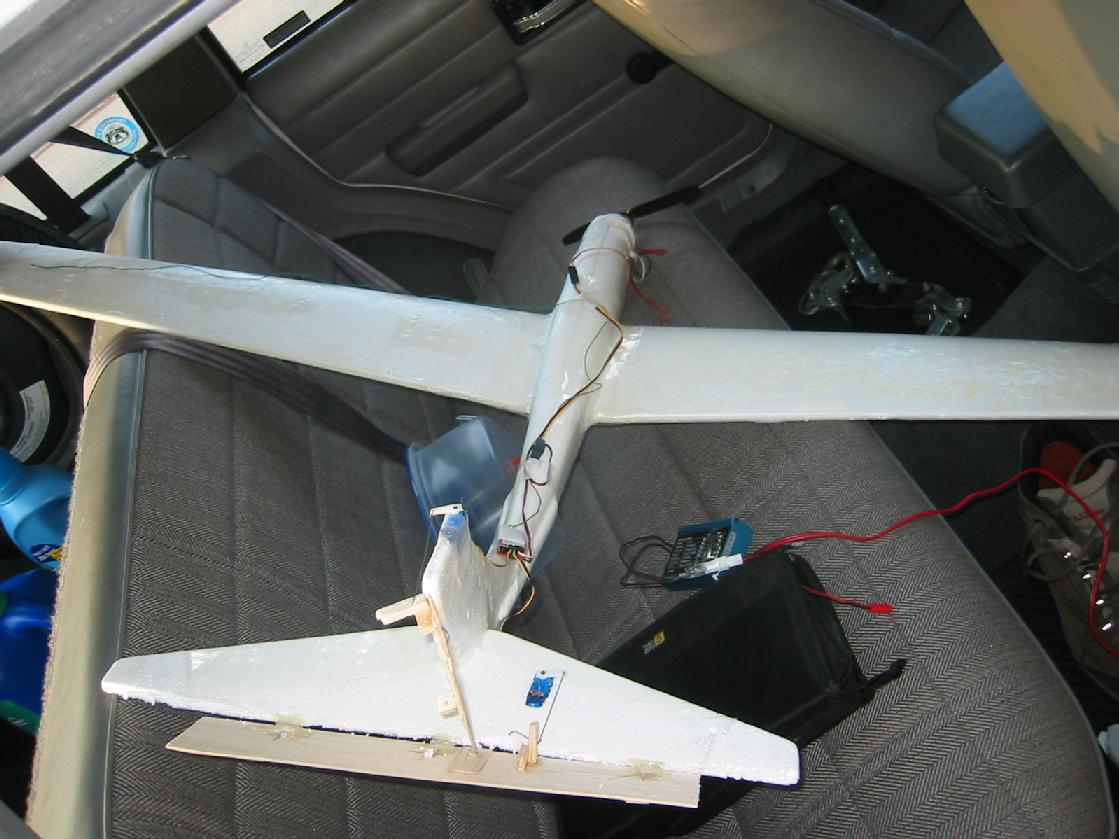
Yesterday we did a first trial of fiberglassing a foam glider, using 1.5oz/yd cloth, and some 20 minute epoxy. It gave us impressive stiffness and strength, but it added some weight too. I think it allows these foam toys to act like a 'real airplane' but I think that also demands some 'real power' to haul it through the sky.
So today after the fiberglass cured, we put on some control
surfaces and the new brushless. Total weight is about 15.5oz. Plane:

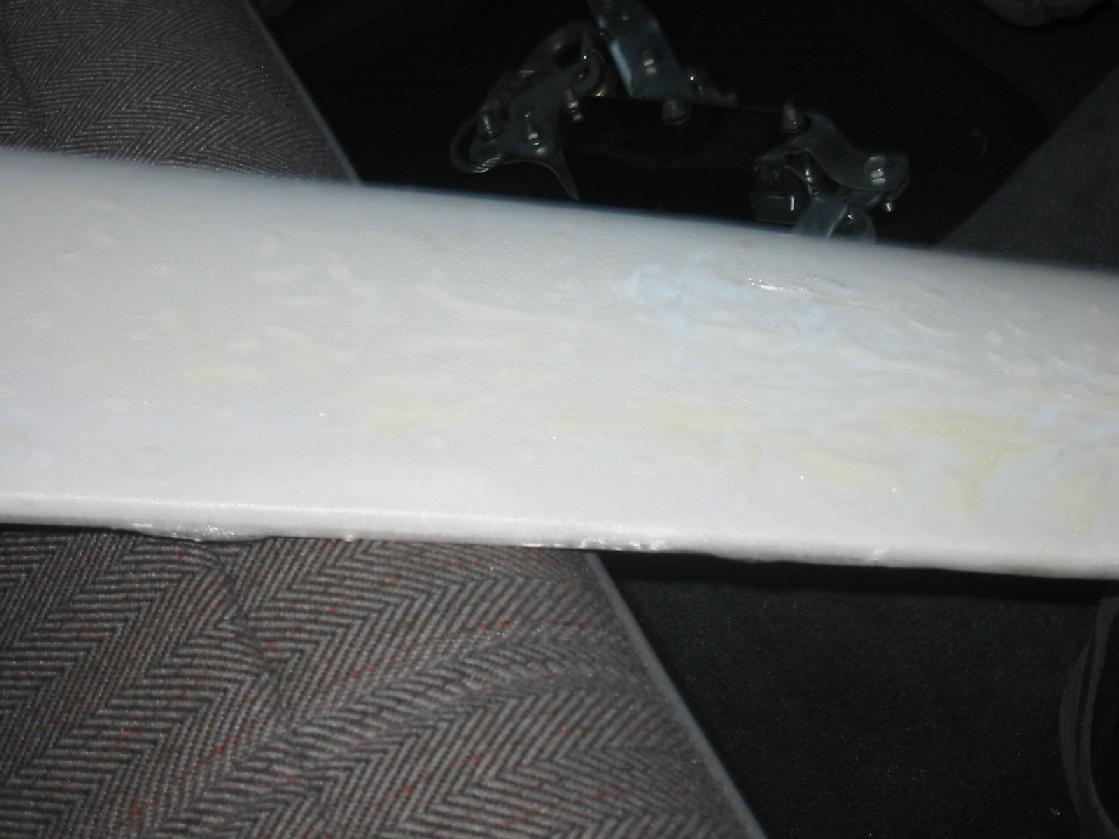
You can see some ripples in the epoxy on one wing:

And here is the motor (with a somewhat dubius prop attachment):

We flew it despite the wind (when in doubt you can always substitute optimism for experience when making decisions such as these). There were a few disadvantageous things going on. One was that the peak cruising speed of this plane was probably substantially below wind speed, and the wind was a little gusty too. Second was that we didn't seem to be getting quite as much power as expected out of the motor, but I think this could be because I'm using an undersized nicad pack (the li-polies are still in the mail). Also it's hard to judge power when your plane is being tossed about willy nilly. I think it would have been able to keep us in the air on a calm day. But the problem I'm actually more concerned about (and which we won't really be able to even definitively diagnose until a calm day), is that it seemed to be weak at the controls. My suspicion is that the wind was too much for these HS-55 servos and it might be time to start using bigger ones (maybe the HS-81s?).
End of the story is that we managed to break the fuselage in two. I did a few more wraps of fiber around the break, and I think it will be fine tomorrow.
I'm starting to develop an opinion that the number one goal should be weight, more than even strength. The majority of our breakups happen on impact, where the weight causes the destruction. It sucks to have your wings flapping around like a toy, but for the type of flying I want to do for the moment, it shouldn't matter (I'm not in search of a sport aircraft). I'm inclined to next fly essentially the same plane, but without any covering.
I'm also getting to have more of a 'no-wind policy' towards flying. I've been building and flying aircraft that are simply too small for heavy wind. I like the 'park flyer' aspect, so I want to keep my aircraft small, so I guess that leads to this no-wind compromise. Even the essentially indestructible super-dihedral gliders start to sustain inverted landing- and cartwheel-related damage on windy days. In general it seems that it's less windy in the mornings here, probably because the sun is responsible for most wind. I'm curious about what parts of the night may also be good.
Also, I was stupid to only buy three props. If I had a bunch more of these props, I would try again tomorrow without hesitation, but as it is, I think I will wait until I get the better battery. I should perform research about which prop alternatives would work. The ones I have are super-light (and also delicate). I think I read something suggesting this motor doesn't like heavy props, but maybe only when the braking feature is enabled in the controll.r
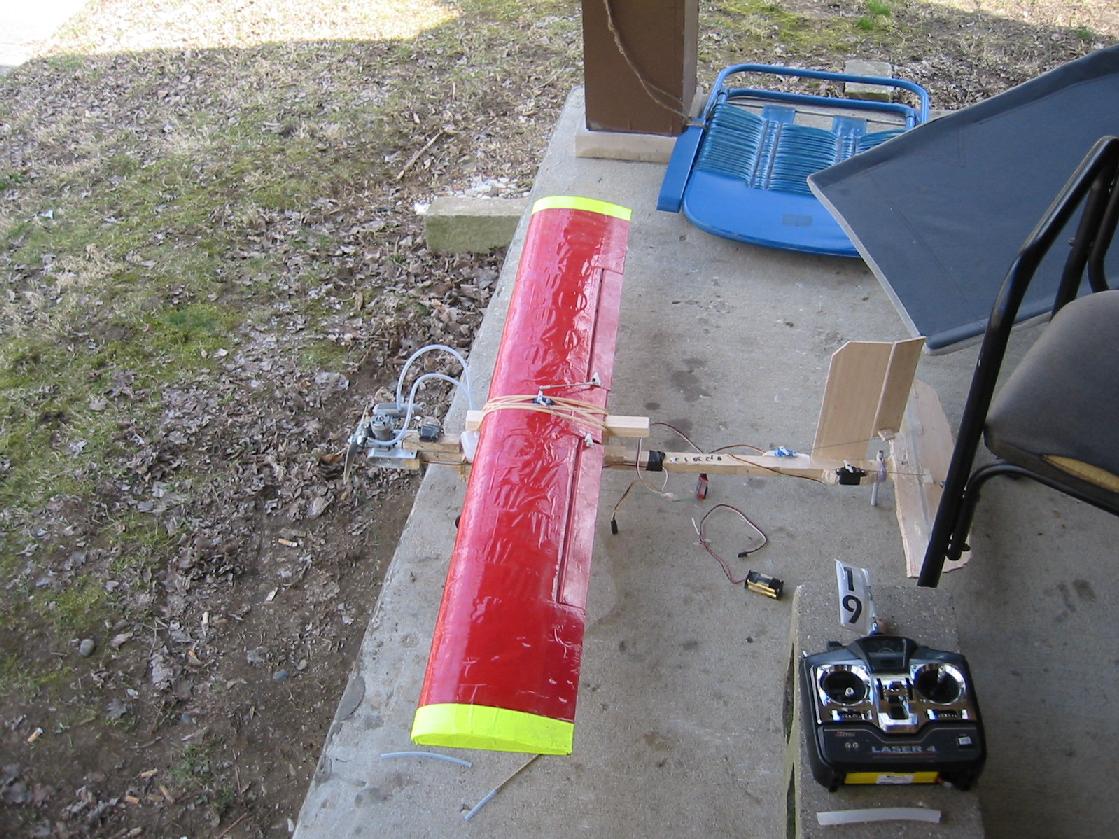
Today we put together and flew the stick plane with the .15 motor we just got. One of the major improvements was a good quality stiff foam wing with ailerons. It has (among other features) a carbon fiber spar of some sort (arrow shaft?). This was loaned to the cause by Eric.
So all together we actually used all 4 channels with servos on each
one. Our most laiden beast. Though I swore not to touch the rudder
so as not to confuse myself. Picture:

Other angle:

We'd flown almost this same plane in the past with a .049 engine and found it to be relatively tame (though not capable of handling much of a breeze), which is how we wanted it. But the .049s aren't throttled so the upgrade was necessitated. The .15. Yow! Being nowhere near underpowered, combined with ailerons and a freakish calm part of the day made this a really satisfying flying experience, even though I did eventually run it into the ground. It was going too fast, so I pretty much pulled the throttle all the way back, and then it wasn't going fast enough, so I slammed it all the way forward (see the problem). From then on, it was just bouncing from one near crisis to another. A very assertive flyer! The elevator that was pretty decent at low speeds was downright terrifying at high. I had to line up every turn precisely before pulling back, because the moment I pulled back, it was like an immediate snap turn.
I am to this moment a little mystified how I managed to get it into the ground. The video (QuickTime, 10.5MB) isn't terribly clear on the subject, but there is reason to believe that it was upside down at some point, and that may have confused me. But the way Kava described it really kind of sums it up: I was going too fast, and I was going too close to the ground. Together those have an obvious extreme endpoint, especially with anything less than perfect reflexes. I think I turned into a turn that I would have wanted to straighten up, and might have done so even enough to actually make it so pulling back sent it further down.
The crash was not so bad. The plane came apart into battery, motor, wing, and fuselage (with tail still attached). The joy of thickish balsa is that it doesn't break, the CA joints break. The aileron servo is a loss (might be able to just get new gears again), and our cheap AAA receiver pack got all the wires ripped off. The prop is of course history, and you can probably tell how fast it hit the ground by how much longer one blade is than the other (presumably, it hit first, then 180 degrees later, the other blade hit and got shortened even more). Would rather have not crashed it and maybe flown again, but overall a very good experience. The plane performed perfectly.
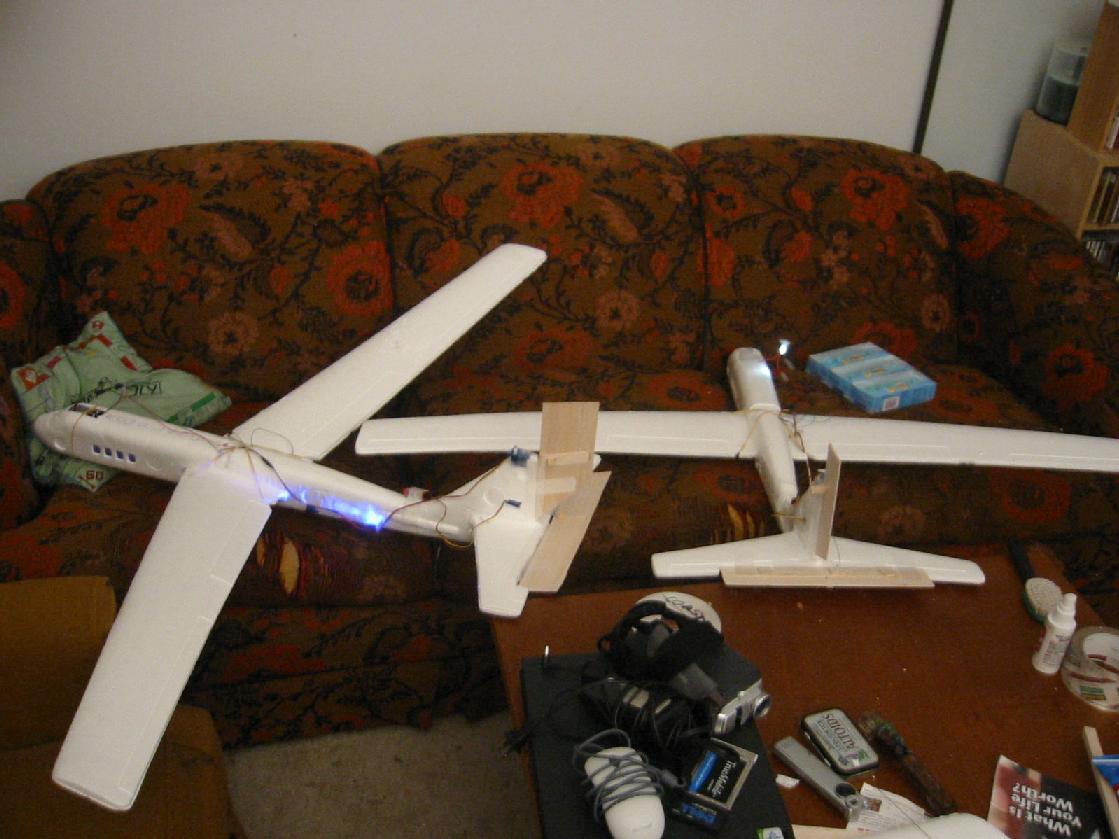
We threw together a glider with some lights for some late night fun.
It turns out that the line where it is too cold for EPP gliders (makes
them way too brittle) is very sudden. We've flown these things
lots of times when it was cold, but last night was just a little bit
colder, and the thing was breaking all over. Ran out of tape so we
just rubber-banded the wings onto the wing stubs after they broke off.
Until the fuselage snapped in two, it actually flew sort of alright,
even when only one wing was broken. Final state:

I tried to get the rubber-power-oriented props on my LensRC motor again. I think I managed to balance two of them well enough, but they still wouldn't go over half throttle. They seem to work smoothly up to about half throttle, but then the motor starts missing and the motor controller turns off. Maybe I should fiddle with the advance settings on my controller. Probably they're just way too pitchy for high-RPM. They don't seem to generate a tremendous amount of pull at low RPMs, though, so I think I may abandon that idea. I should try the middle-sized props I guess.
I flew the rudder-elevator foam plane for a while at the park with a Cox nylon 6x3 (because it's the only prop the motor seems to like that I happen to have not broken yet). I glued on a prop saver and it seemed to mostly do its job (though in the end I let a kid fly it into some concrete and that broke the prop saver...the prop is fine though). With the 6x3 it is pretty much at the bare minimum to be able to gain altitude at all, but it does work. Really hard to recover from a near miss with the ground or a tree and regain altitude, especially because I was flying in such a small park on such a steep hill, I usually would have to turn and start gaining altitude right away. Again, this rudder-elevator thing sucks for tooling around in tight spaces.
It's amazing how much of a difference small details like tape can
make. We'd been using medical tape for everything, but then I got
some good electrical tape which really makes a very strong attachment
if you can get a wrap all the way around something. So I electrical
taped the motor bearing onto the motor mount stick, and the result was
that every nose-down landing (*shrug*) it would break the stick,
rather than the tape. We would just put in another set of sticks each
flight. When I pulled the sticks out of the foam this morning, I
found quite a few broken off inside it:
,
so I decided to switch back to the medical tape, which has an
anti-rip-stop property which makes it rip whenever the motor experiences
trauma, rather than breaking anything else.
Anyways, the plane is spending the night in a tree. So I have performed some research (read a few threads on rcgroups.com), and it appears that there are a few popular approaches for getting planes out of high spots in trees (defined as, where a ladder gets useless):
I really don't see how we as a species have allowed these hazards to navigation to dominate the surface of the planet so thoroughly!
I decided that I couldn't allow the loss of a plane to slow me down, at least not until I lose too many parts. So I decided to build a light-weight lazy-person's version of the Wally wing. The idea is to take just the wings from one of the foam gliders and put them together in a way not dissimilar from the Zagi or CombatWings aircraft. Ken uses spruce spars and a speed 400 motor and lots of care. I decided this needed to be Gregified.
Ingredients:
Total flying weight of 4.5oz-5oz (depending on tape, quarters, etc.). Pretty nice for being about 1.5 square feet of wing area.
Top:

Bottom:

With the equipment cover removed:

With creator:

I'm still having a lot of trouble getting plane-like performance out of flying wings. I worked out the center of gravity for level flight by taping quarters onto the wing until a hand toss in my livingroom went level. Then once I got the controls on it, I tried that spot +/- about half an inch (by taping quarters onto it, again). I found that some spots were better than others, but I didn't find any spot where it would perform well at all at low speeds. It seemed like the flight characteristics and the control reaction were all totally crapulent unless it was going pretty fast. In other words, it always seemed to be flying just past stalled, at least from a controls perspective.
I think part of the problem is that I didn't make big bold to-the-wingtips elevons. I'm not sure how the wing works at varying speeds, but I bet the wingtips matter more at lower speeds or similar, and that would explain why controls were only reactive at high speeds (when they were reactive, they were pretty dramatic).
I did get to try some new construction techniques. This is another satisfying use for hot melt glue. To hold the wings together, I decided to forego everything complex/heavy/strong. At the center I just had a single wrap of packing tape. Then after I broke the wing (it has a habit of landing hard on a wingtip...in fact it seems to fly through the air as well like a javelin as a wing) I added a single strip along the top and bottom of each wing, towards the front of the wing. The wings are getting all sorts of warped (to no apparent effect, heh), but they have survived lots of impacts with just this little amount of tape. This is also the first plane I've built with a fuselage around the equipment rather than simply taping stuff on. I pretty much just cut up random scraps of foam to make walls for the equipment area (mostly because I wanted to protect the new li-poly battery). I have to say it worked out quite well -- usually I have a battery go flying around at least once in a night, but this prevented all the nuissance behaviour while also protecting the battery and wire.
I think the biggest deviation from Wally Wing that probably impacted stability a lot were my elevons that were all alone on the trailing edge and covering only a small percent of the back of the wing. On most other flying wings I've seen the elevons covered most of the back of the wing (or at least were pretty far out along the wing). The wally wing in particular has a much cleaner trailing edge all around. I would just tape on elevon extensions, except that this wing flexes a good amount, and that makes ailerons and elevons weird. In fact that may be the entire problem -- can't wait until I stiffen it up with fiberglass.
In the future I'll want to add a brushless motor (1-2oz) and some thin fiberglass (1-3oz) and maybe cut the wing down a bit in size. The success of a small amount of tape at providing strength leads me to believe that even a thin layer of fiberglass will make a light wing virtually indestructible.
I just got back from throwing it around with extensions taped onto the elevons to bring them almost to the tips of the wings. Much improved! It behaves much more plane-like. But the flex of the wings is a real problem, as anticipated. The elevon tips pretty much ripped off their tape as the wing pounded into the ground. When it got back inside it was an ounce heavier from all the water and mud *sigh*.
Shortly after my last entry, I bought a house and I've been too broke and overwhelmed to play much since. But I *do* have a huge workbench in this house, so...
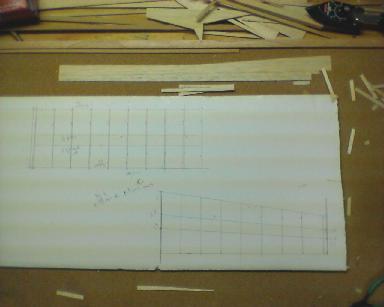
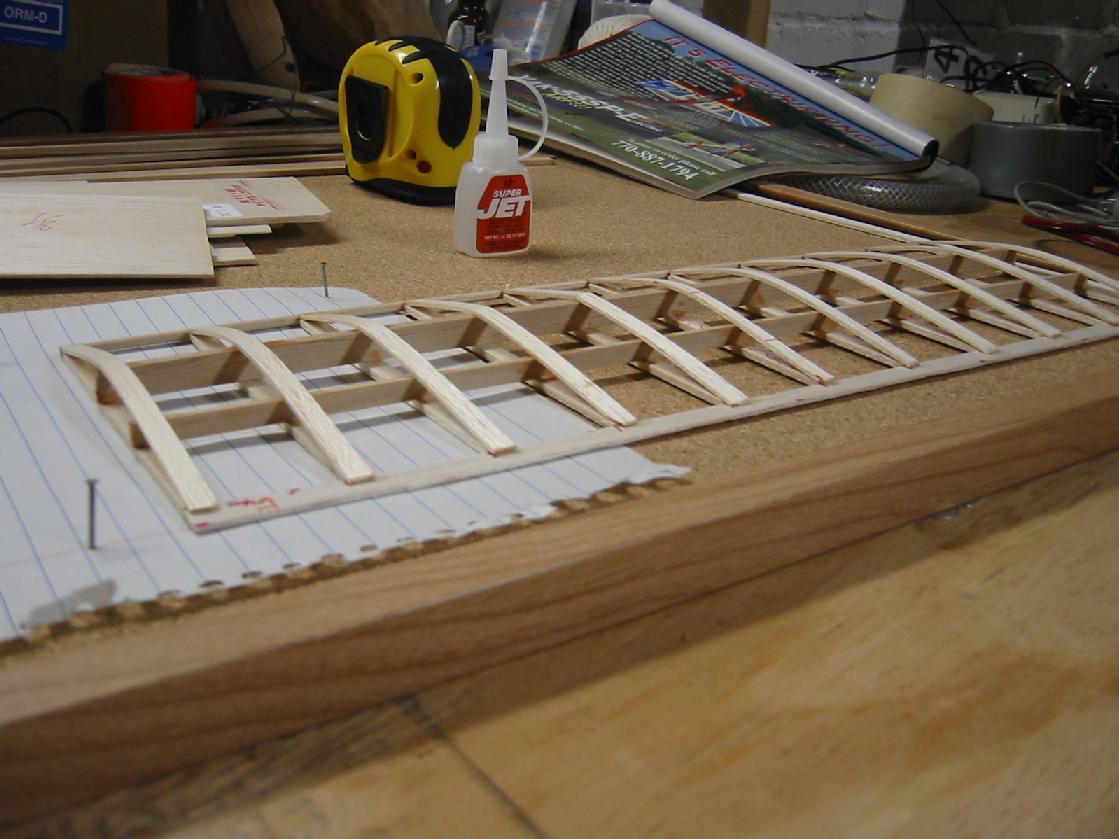
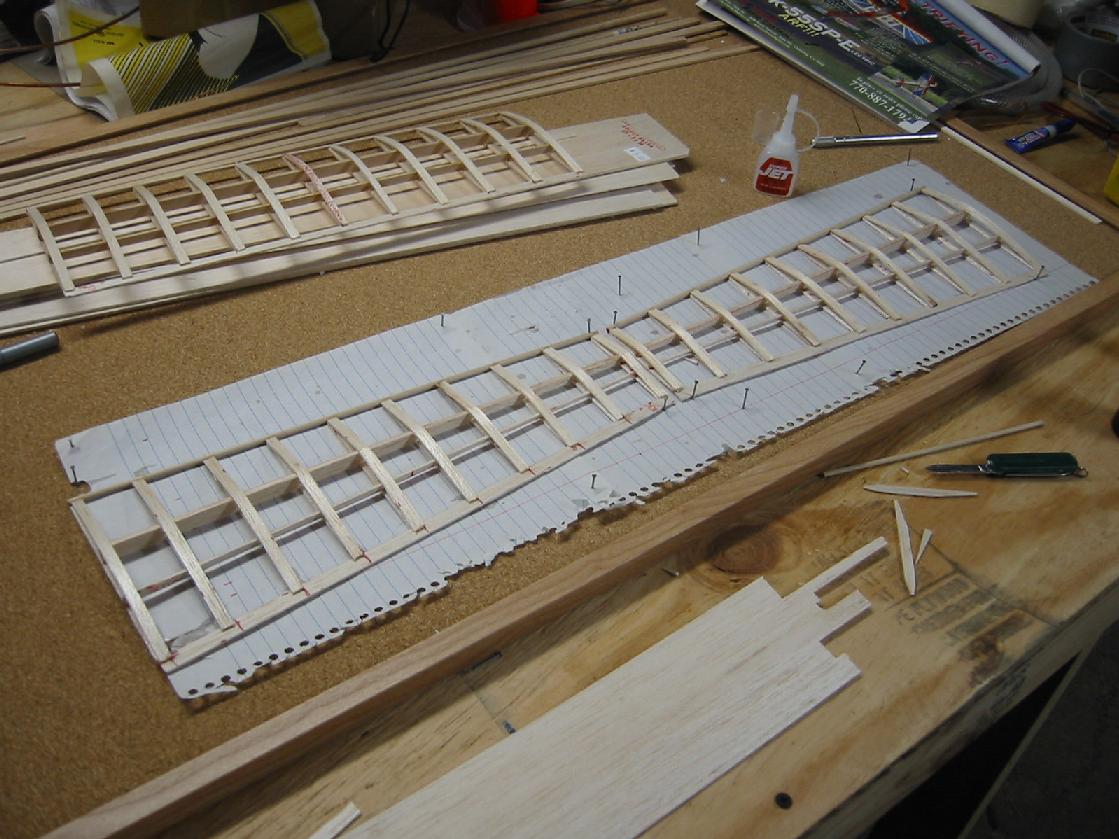
A few months ago (Feb 2005 Model Aviation) I saw plans for Bob Aberle's Scratch-65 (a 65% scaled down extra light version of the Scratch-One, published there before I subscribed to MA). It is designed to introduce us new timers to the art of balsa stick construction, so it features an interesting shortcut. Instead of cutting out a zillion little ribs, there were just bent sticks of balsa over the top of the spars. I decided I would build one.
The Scratch-65 was too small (Bob was using super-micro servos and receiver that I do not have), and I couldn't conveniently get ahold of Scratch-One plans, so I went ahead and built one a little bit smaller, say a Scratch-90. Hopefully its flight characteristics will not suffer too much from the number of decisions I had to make in this approach.
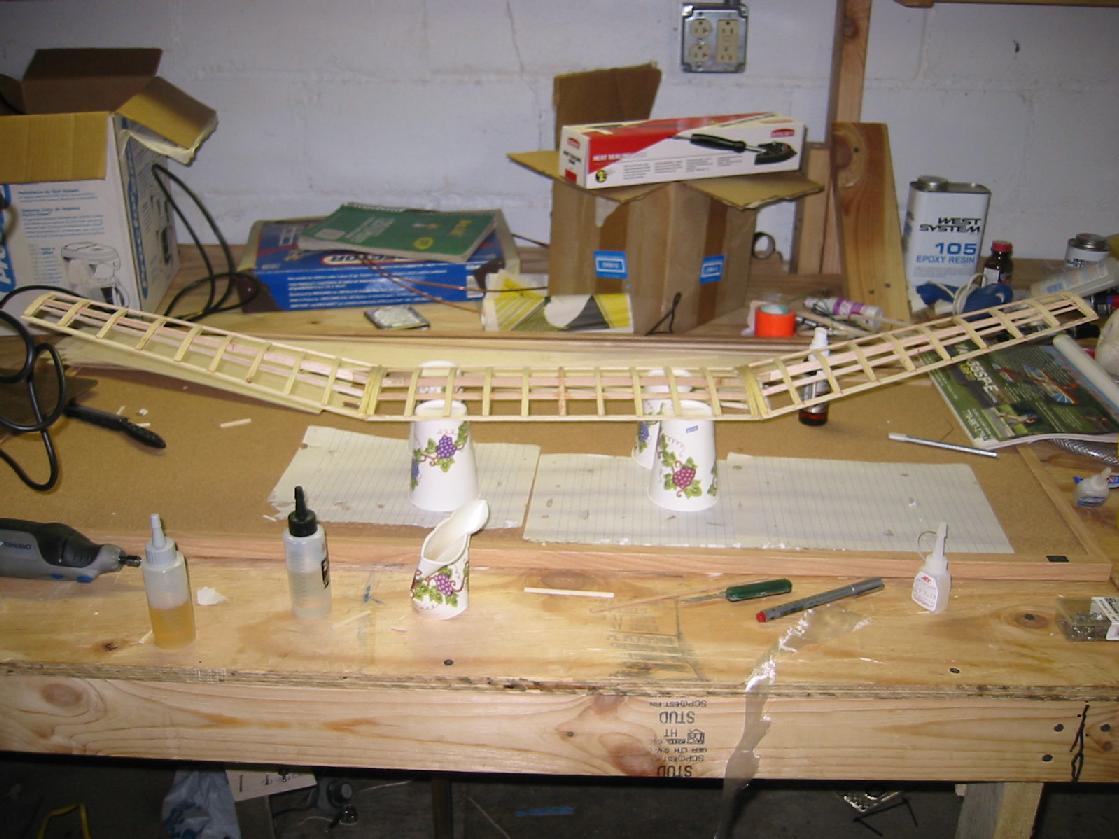
The wing features polyhedral (a flat center panel with two raised
tip panels). Here is the center panel:

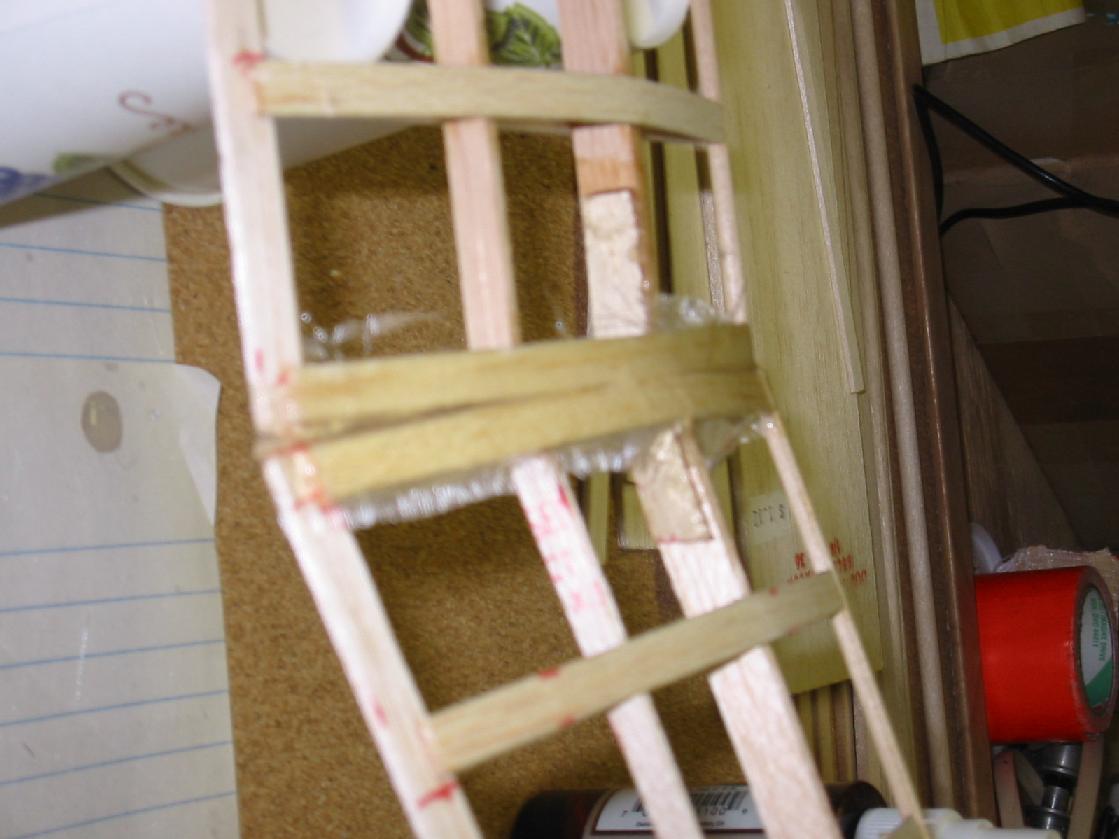
If you look closely, you can see that some of the balsa sticks broke
at the apex of the bend (over the main spar). I eventually determined
that this was actually occuring after I lifted my fingers off the
sticks -- I think that some glue-related process was causing an
increase in tension. Probably a particular pattern of glue
application would have solved this problem, but I didn't figure it
out. I solved it by fiat, declaring that since they were still
strong, they were still airworthy.
Here are the tip panels fresh from assembly:

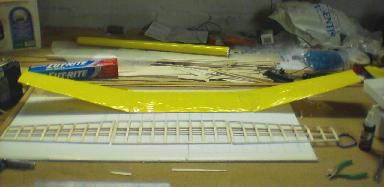
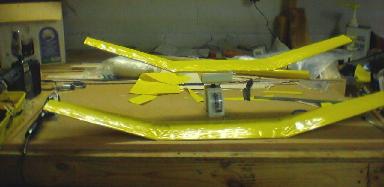
Here is the complete wing (still without covering).

The plans called for an angled cut of 1/64th inch plywood to hold the tip
panels on, but that didn't seem sufficient to me (perhaps I didn't
understand something). So I also
super-glued on tiny bits of balsa to fill the gaps at the LE/TE of the
join and wrapped the whole join with a thin strip of scrap fiberglass (1/2oz,
I believe) and epoxy:

Tomorrow (epoxy willing) I will cover it with MonoKote.